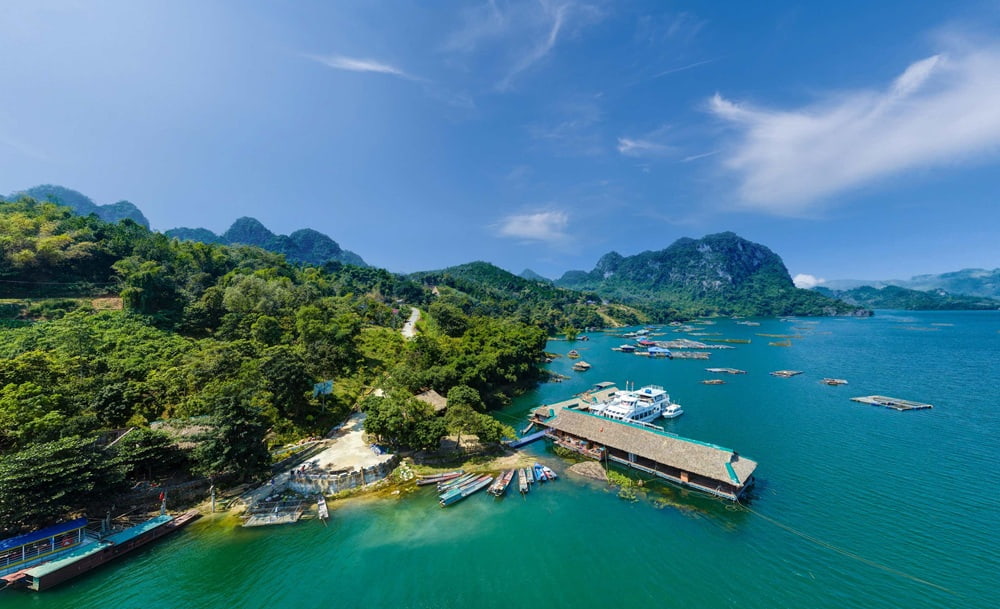
Wide aerial shot of Ngoi Hoa Village at sunrise (Source: Collected)
Why Ngoi Hoa Village Feels Different From Anywhere Else Near Hanoi
The first thing that sets Ngoi Hoa apart is the journey itself. You do not simply arrive - you earn the arrival. After a two-and-a-half-hour drive from Hanoi, the road runs out at a small pier, and the final stretch is done entirely by boat, gliding between limestone islands with the engine as the only sound for miles. For travelers used to fighting Vietnam's motorbike traffic, that sudden quiet is often the moment the trip actually begins.
The second thing is scale. Hoa Binh Lake is the largest man-made lake in northern Vietnam, and Ngoi Hoa Bay is one of its most photogenic corners, ringed by limestone cliffs and dotted with small islets that locals once called "Bua Ram" - a name that roughly translates to "thick, fertile wilderness," describing how untouched the area looked before tourism arrived. One especially scenic pocket of the bay, known locally as Dragon Eye Lake, is famous for water so clear it turns emerald green under the afternoon sun, and folklore says it was once where mountain girls came to bathe undisturbed.
The third and most lasting impression is the people. Ngoi Hoa is still home to Muong families living in wooden stilt houses along the shoreline, farming, fishing, and keeping traditions that have mostly disappeared from more accessible parts of Vietnam. Because so few foreign travelers make the effort to get here, a visit still feels like a genuine encounter rather than a performance staged for cameras - which is precisely what makes it worth the extra effort of the boat ride.
How to Get to Ngoi Hoa Village From Hanoi
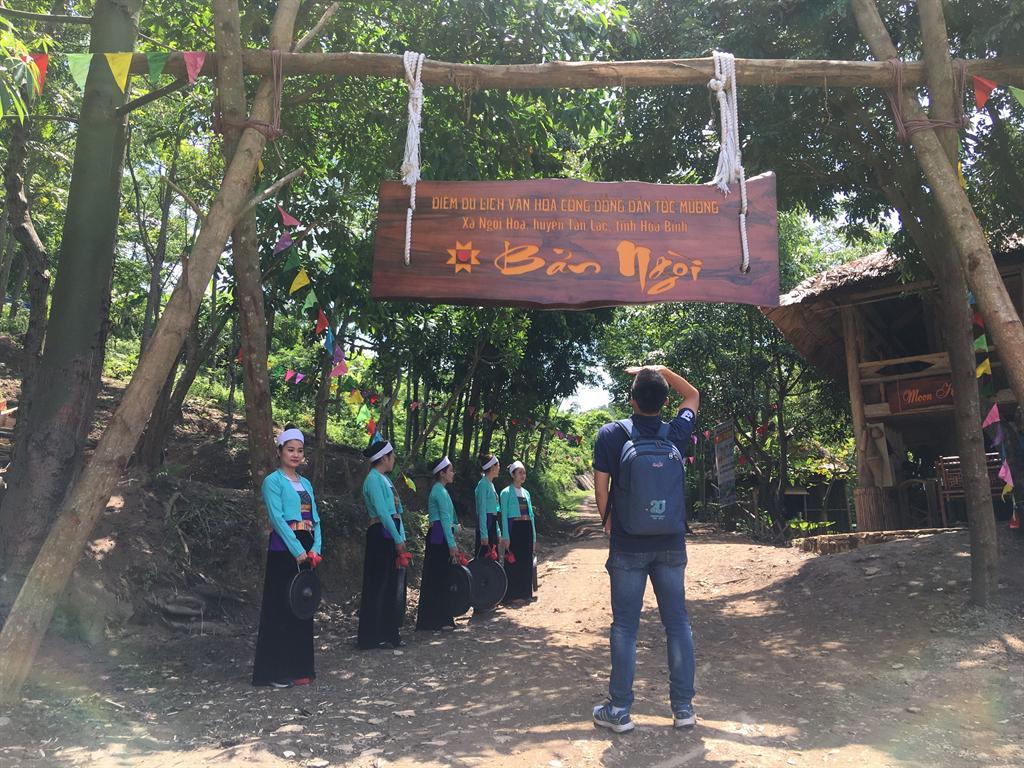
Ngoi Hoa Village's life (Source: VietnamNet)
Ngoi Hoa lies about 134 kilometers from central Hanoi, but the distance is only part of the story - the route combines a scenic road trip with a short lake crossing that most visitors end up calling the best part of the day. Understanding the two-stage journey in advance will save you time and confusion once you're on the ground.
- Stage one: Hanoi to the pier: Drive along Thang Long Boulevard, then the Hoa Lac–Hoa Binh Expressway toward Hoa Binh City, before continuing through Cao Phong and Tan Lac districts to either Thung Nai Port or Bich Ha Port. By private car or motorbike this takes roughly 2 to 2.5 hours. Budget travelers can catch a public bus from Hanoi's My Dinh or Yen Nghia bus stations to Hoa Binh City for around 100,000–150,000 VND, then continue to the pier by taxi or motorbike taxi.
- Stage two: pier to Ngoi Hoa by boat: From Thung Nai or Bich Ha Port, boats cross the lake into Ngoi Hoa in 40 to 60 minutes depending on the vessel. Traveling as a family or small group makes it worth chartering a private boat, since the same trip can be combined with stops at Thac Bo Temple or other islets scattered across the lake.
|
Transport stage
|
Method
|
Approx. time
|
Approx. cost
|
|
Hanoi → Hoa Binh City
|
Private car / motorbike
|
1.5–2 hrs
|
Self-drive
|
|
Hanoi → Hoa Binh City
|
Public bus (My Dinh/Yen Nghia)
|
2-2.5 hrs
|
~100,000-150,000 VND
|
|
Hoa Binh City → pier
|
Taxi / motorbike taxi
|
30-45 min
|
Varies
|
|
Pier → Ngoi Hoa
|
Boat
|
40-60 min
|
Varies by boat size
|
If you would rather skip the logistics altogether, staying at a lakeside resort that already runs its own boats is the simplest fix. Guests based at Mai Chau Hideaway Lake Resort typically combine the whole route into a single planned transfer, arriving by road and finishing the trip by private boat directly to the resort's own pier on Hoa Binh Lake, with Ngoi Hoa and Ngoi Hoa Village easily reached as part of the same crossing.
Top Experiences in Ngoi Hoa Village And Ngoi Hoa Village
Exploring the village by kayak or bamboo raft is the activity most visitors remember longest. Paddling quietly around the small islets at sunrise, before the day's heat sets in, lets you get close to the limestone cliffs and fishing rafts in a way a motorboat never could. Many travelers pair this with a visit to Thac Bo Temple and its adjoining cave, where locals still come to pray and where stalactite formations have been shaped by the lake's water level over centuries.
For families, a floating inflatable water park anchored on the lake gives kids a place to burn energy between quieter cultural stops, while adults can simply relax at the water's edge. If your timing lines up with the mid-month full moon, ask locally about joining a lakeside tea-and-moon-viewing outing - small boats drift out onto the still water after dark, and the combination of lantern light, tea, and silence is the kind of detail that rarely makes it into standard tour itineraries.
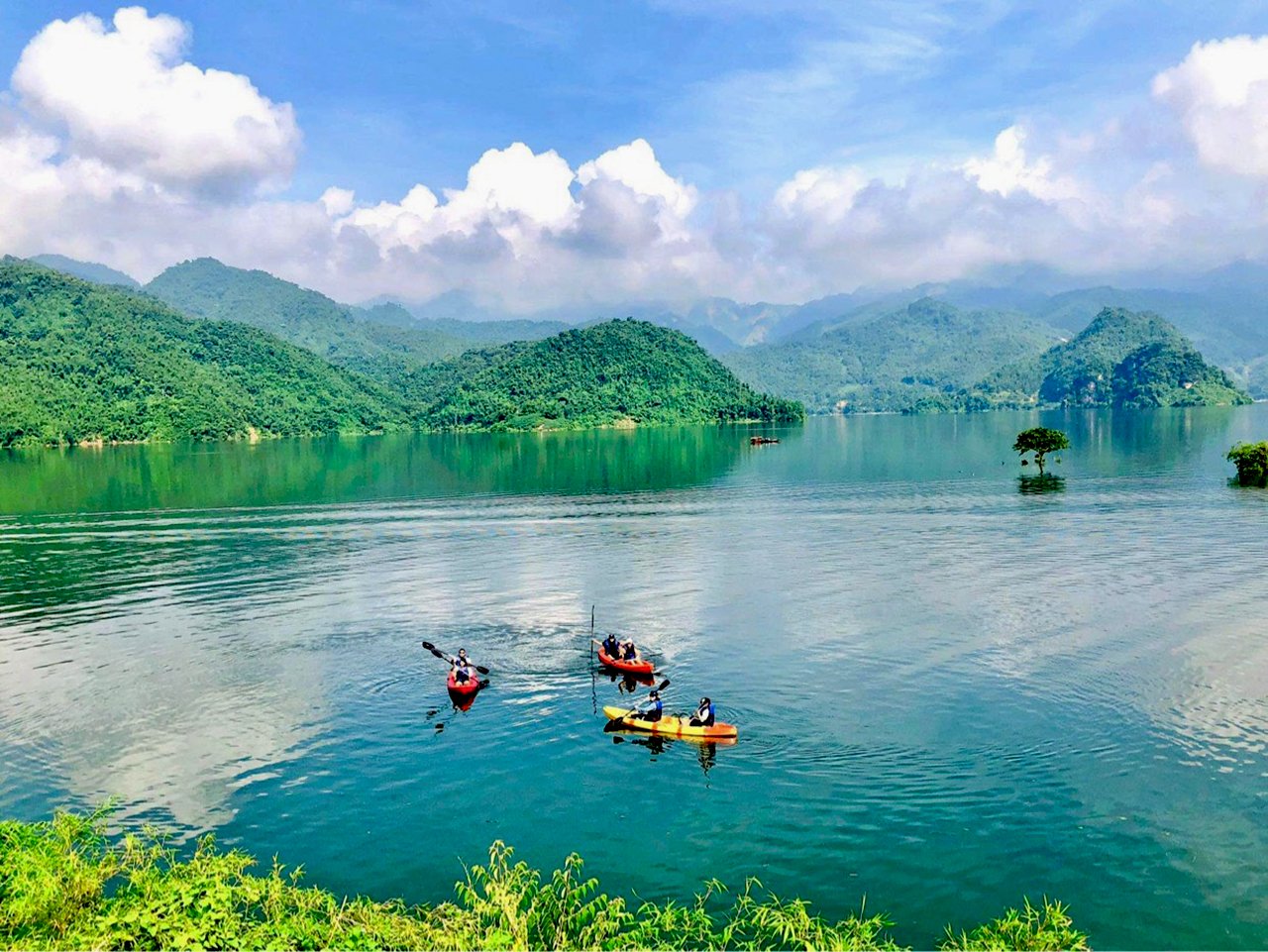
Traveler kayaking between limestone islets in Ngoi Hoa Village with golden late-afternoon light on the water (Source: Collected)
Muong Culture in Ngoi Hoa: Stilt Houses, Folk Music, and Handicrafts
Ngoi Hoa has been home to the Muong ethnic community for generations, and unlike villages that have been rebuilt for tourism, much of the daily rhythm here has stayed intact. Walking through the hamlet, you will notice wooden and bamboo stilt houses raised above the ground, a building style designed for the region's humid climate and occasional flooding, still lived in rather than kept as a museum display.
Cultural performances happen here too, but on a smaller, more community-driven scale than in bigger tourist towns. Gong ensembles, the sen tien fan dance, and traditional Muong singing are usually performed close enough that it feels more like being invited into a local gathering than watching a scheduled show. If your visit happens to overlap with a village market day or seasonal festival, it is worth rearranging your schedule to catch it - these events offer a far more candid look at daily life than any organized tour can.
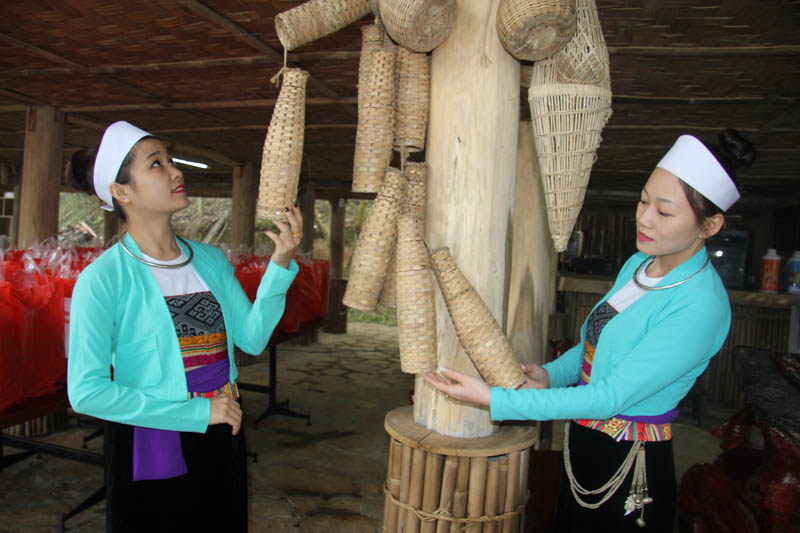
Culture of Ngoi Hoa Village (Source: Collected)
Several families in Ngoi Hoa still practice traditional handicrafts, weaving bamboo and rattan into baskets and household goods, or keeping bees for honey the way their parents did. Spending even twenty minutes chatting with a local artisan, even through a guide or translation app, tends to add more understanding of the region than an entire afternoon of sightseeing. As with any homestay-style visit, remember to remove your shoes before entering a stilt house, keep noise down in the evening, and always ask before photographing residents.
What to Eat in Ngoi Hoa Village: Northwestern Flavors Worth Traveling For
After a day on the water, meals in Ngoi Hoa tend to be the highlight travelers talk about once they get home. The food here leans on what the lake and surrounding hills naturally provide - fresh fish, free-range chicken, forest greens, and glutinous rice - prepared simply but with real skill.
Grilled Da River fish is the dish most associated with the area: whole fish, skewered on bamboo and grilled slowly over charcoal until the skin crisps and the flesh stays sweet and firm. Chicken simmered with sour bamboo shoots is another local staple, balancing the richness of free-range chicken with a light, tangy broth that Muong families have been making for generations. If you're feeling adventurous, buffalo meat with "la lom" leaf - a slightly sour local herb - is a genuine regional specialty that is hard to find outside Hoa Binh.

Grilled Da River chicken (Source: Collected)
Sticky rice cooked in bamboo tubes (com lam) and glutinous "nep nuong" rice usually round out the meal, served with roasted peanuts and salt or alongside the grilled meats. Many visits end with rượu cần, a communal rice wine sipped through long bamboo straws from a shared jar - a Muong tradition tied closely to gatherings and celebration, and one that foreign travelers are almost always invited to join rather than just observe.
Best Time to Visit Ngoi Hoa Village
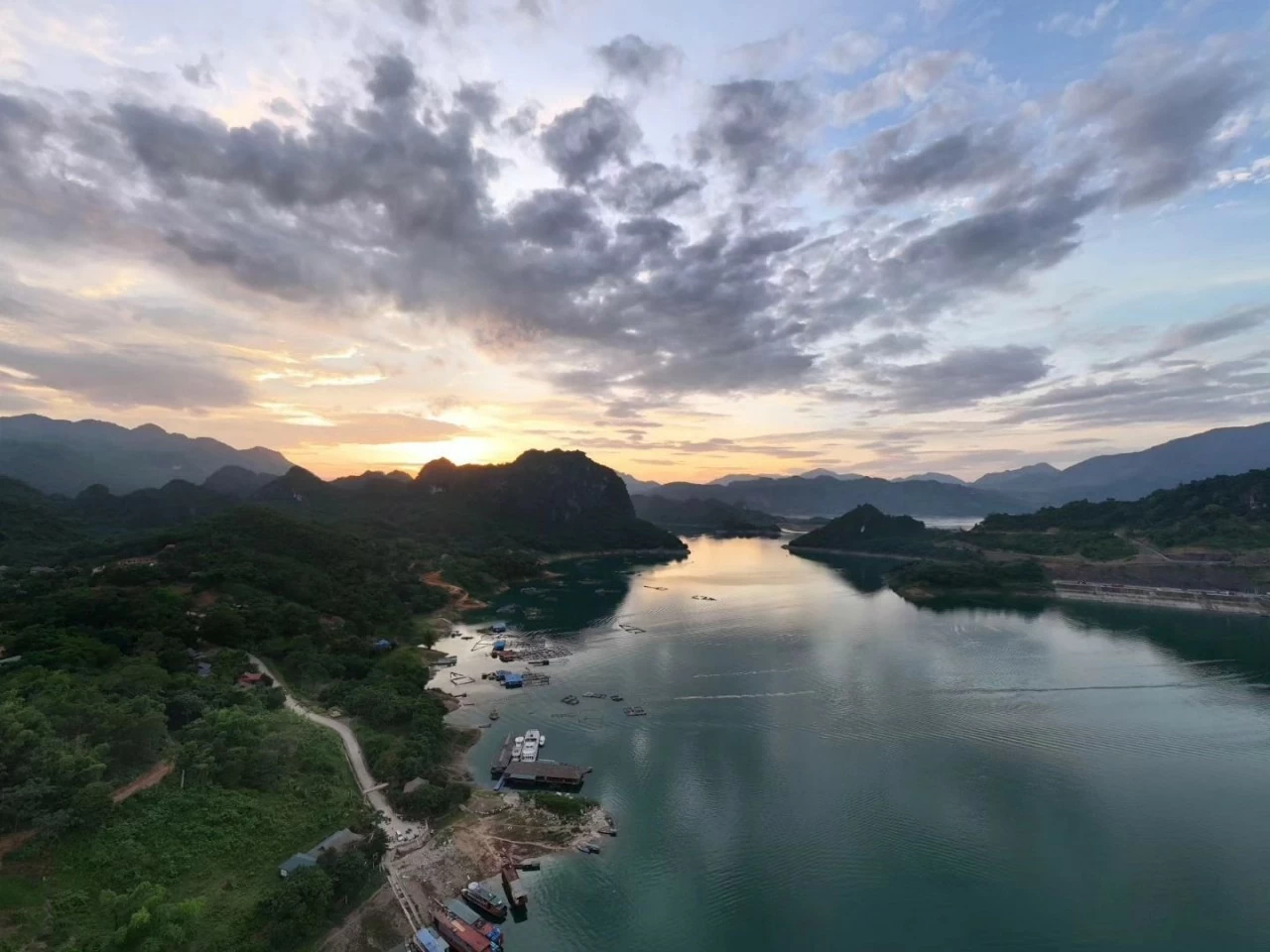
Choose the best time to come Ngoi Hoa Village (Source: VietnamNet)
Hoa Binh Lake's climate is milder than much of northern Vietnam, so there is no single "wrong" season to visit - but the experience does shift noticeably depending on when you go, so it's worth matching the timing to what you actually want to do.
- From May to August, the lake is at its liveliest. Water levels are high, the weather is warm and mostly dry between showers, and this is the best window for kayaking, swimming, and enjoying the floating water park. If your main goal is being active on the water, this stretch of the calendar suits you best.
- From September through April, the pace slows down. Cooler, drier air makes for comfortable walking and boat rides, and this period suits travelers who want to relax, take photographs, and soak in the scenery rather than swim. Early mornings in autumn and early winter often bring a light mist over the bay, which is when the limestone islets look their most dramatic - well worth setting an alarm for.
Whichever season you choose, keep an eye on the weather forecast in the days before you travel, especially during the rainy months. Sudden rain can change the lake's water level and affect boat schedules, so building a little flexibility into your itinerary is a smart habit here, just as it would be for any lake or river destination in Vietnam.
Practical Travel Tips for Ngoi Hoa Village
A little preparation goes a long way in an area that is still relatively undeveloped for tourism. Here is what past visitors consistently recommend before setting out.
- Book your boat and homestay in advance, especially on weekends and during Vietnamese holidays, when boats and rooms fill up quickly and last-minute prices tend to rise.
- Always wear a life jacket on the water: The lake is generally calm, but it is deep in places, and a life jacket is a non-negotiable safety basic here.
- Bring cash: ATMs and card payments are scarce once you're on the lake, so carry enough Vietnamese dong for meals, boat hire, and local handicrafts.
- Check the weather before you go, particularly from September to January, when rain can affect water levels and boat departures.
- Respect Muong customs if you stay in a stilt house: remove your shoes before entering, keep noise low in the evening, and ask before photographing people.
- Pack motion sickness tablets if you're prone to seasickness, since parts of the boat journey can take close to an hour.
Where to Stay Near Ngoi Hoa Village: Mai Chau Hideaway Lake Resort
If you want to explore Ngoi Hoa without roughing it in a basic homestay, basing yourself at a resort on the same lake is the easiest way to get both comfort and easy access to the village. Mai Chau Hideaway Lake Resort sits on a peninsula in Suoi Lon Village, Tan Mai Commune, facing directly onto Hoa Binh Lake, roughly 130–140 kilometers from Hanoi and within boat range of Ngoi Hoa and Ngoi Hoa Bay.
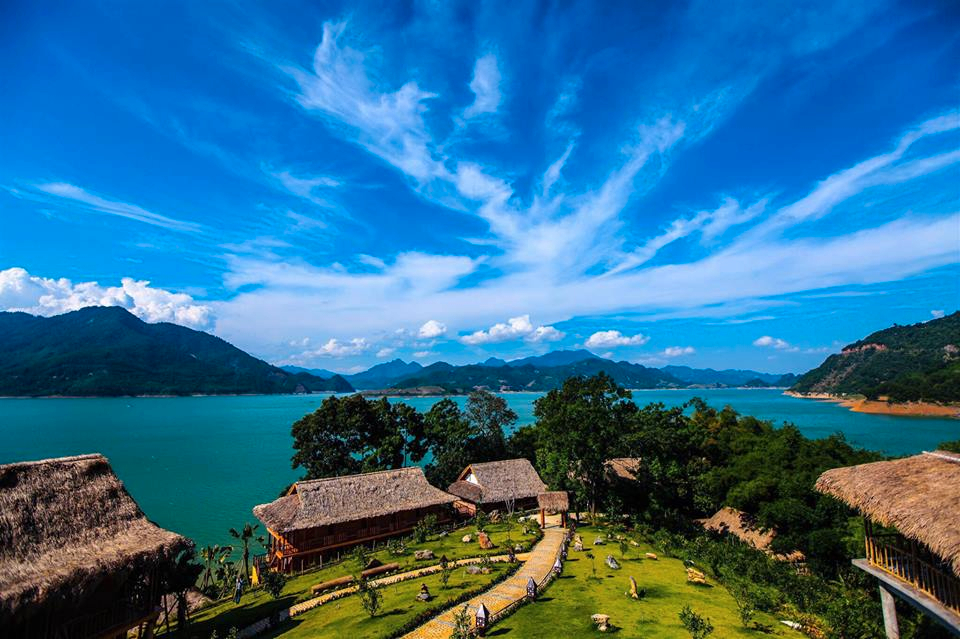
Mai Chau Hideaway Lakes Resort surrounded by Hoa Binh Lake and forested mountains
The resort is built in the stilt-house style shared by the Thai, Muong, Dao, and Hmong communities of the Northwest, so the architecture itself already sets the tone for a trip built around local culture. Its infinity pool overlooks the lake and mountains, and guests regularly use it as a base for kayaking, bamboo rafting, and short boat trips to nearby islets - including the route into Ngoi Hoa and Ngoi Hoa Bay. In the evenings, the resort also organizes folk performances and cooking sessions, so the cultural side of the trip does not end when the boat comes back to the dock.
A recent family stay shows what that experience can look like in practice. In early July, guest Dang Thuy Ha brought her husband and son - home for the summer after months studying abroad - to Mai Chau Hideaway to mark her husband's birthday as a full family, something their busy schedules rarely allow. She later shared that the resort had quietly decorated their villa with birthday messages before she'd even mentioned the occasion to staff, and that the restaurant team surprised the table with a cake and a birthday song that evening, with nearby diners joining in as if they were old friends.
The next morning, the family paddled kayaks together across the still lake, pausing near a couple of local fishermen pulling in their nets - a small, wordless exchange she described as capturing the whole point of the trip. For her, the resort's name felt earned rather than just marketing: a place to step away from daily noise and reconnect with family, not just scenery.
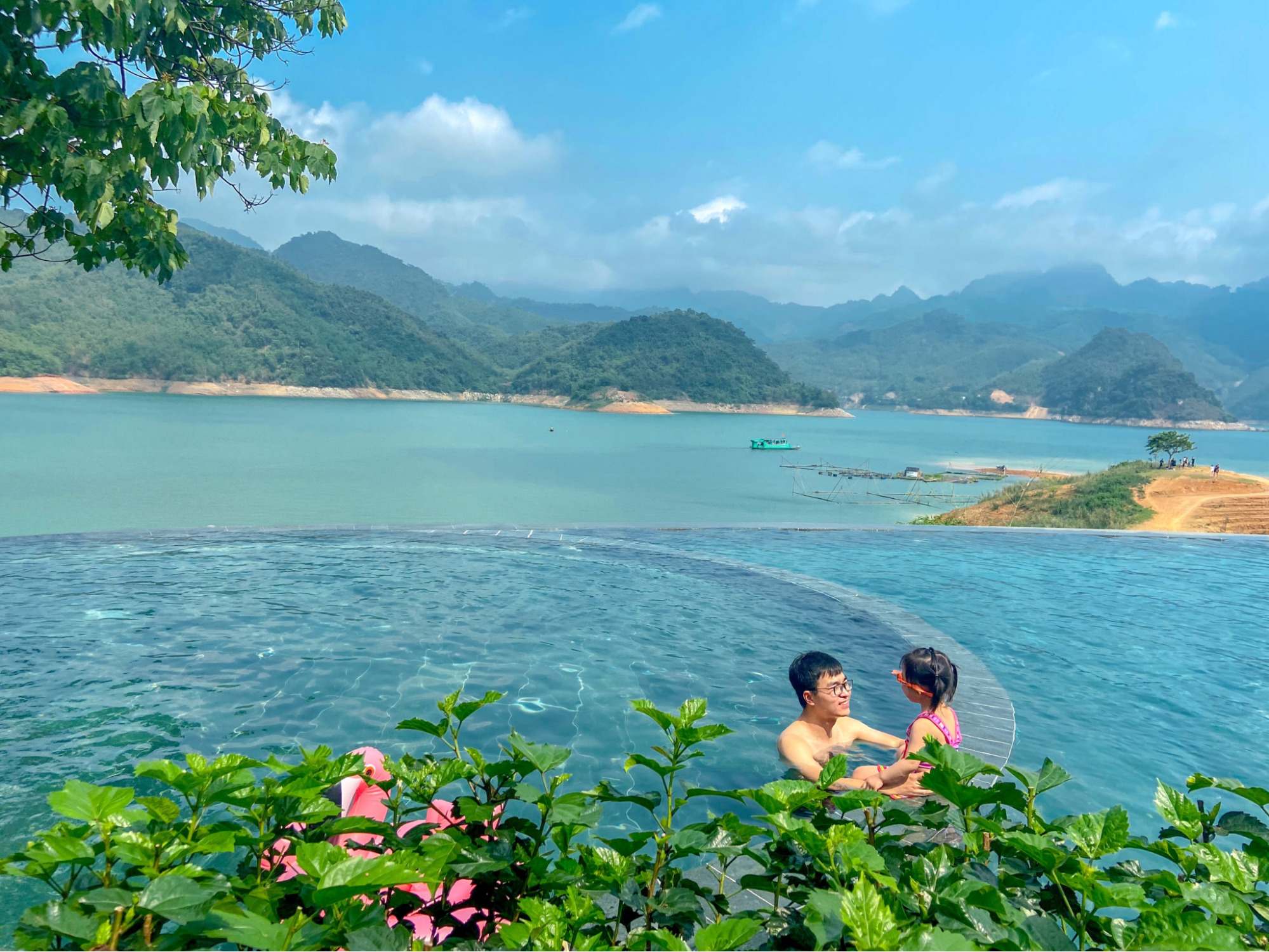
Infinity pool at Mai Chau Hideaway Lake Resort at golden hour, overlooking Hoa Binh Lake and forested mountains
Rooms range from cozy Standard doubles to spacious Family Suites, all facing the lake, and every stay includes a complimentary afternoon tea. Browse the full Accommodation lineup to match a room to your group size and budget before booking directly.
Read more: Chieu Cave guide: How to visit, explore, and enjoy Mai Chau’s natural treasure
A Sample 2-Day Itinerary: Ngoi Hoa Village and Mai Chau Hideaway
If you only have one weekend, this itinerary blends resort comfort with a proper day of exploring Ngoi Hoa and the surrounding Village- enough to feel like a real getaway without needing extra days off work.
Day 1: Leave Hanoi in the morning and drive toward Mai Chau Hideaway Lake Resort, stopping along the way for photos of the Northwest mountain scenery.
After checking in and a lakeside lunch, take the resort's boat into Ngoi Hoa Bay and Ngoi Hoa Village, where you can walk through the hamlet, visit a stilt house, and try kayaking or bamboo rafting as the afternoon light turns golden over the water.
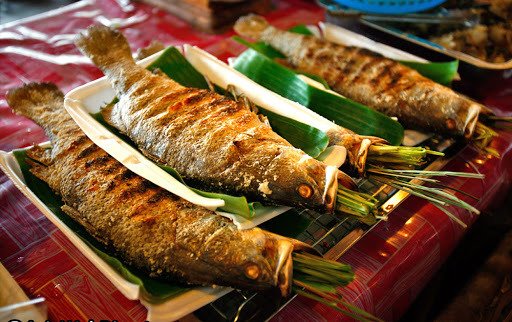
Return to the resort for dinner featuring grilled Da River fish, sticky rice, and other Northwestern specialties
Day 2: Wake early for sunrise over the lake, then spend the morning at your own pace - a kayak session, a walk around the resort grounds, or simply coffee on your balcony. On the way back to Hanoi, stop at Thac Bo Temple and its cave for a short cultural visit and lunch before continuing the drive home, wrapping up a trip that mixes nature, culture, and genuine rest.
For travelers who want more time on the water, our 3-Day 2-Night Kayaking and Cycling tour extends this same route further into Pu Luong Nature Reserve, giving you a fuller picture of Hoa Binh's mountains and lake in one trip.
Frequently Asked Questions About Ngoi Hoa Village
Is Ngoi Hoa Village accessible by road?
→ No. The final leg of the journey can only be completed by boat from Thung Nai or Bich Ha Port, which is part of what keeps the village so peaceful.
How long does the full trip from Hanoi take?
→ Plan for roughly 3 to 3.5 hours door to door, combining a 2 to 2.5-hour drive with a 40 to 60-minute boat crossing.
Is Ngoi Hoa Village suitable for children?
→ Yes, especially with the floating water park nearby, though supervision is essential on and around the water at all times.
Do I need to book a tour, or can I go independently?
→ Both are possible. Independent travel is doable with some planning around boats and homestays, but staying at a lake resort that runs its own transfers, like Mai Chau Hideaway, removes most of the logistical guesswork.
Ready to see Ngoi Hoa Village for yourself? Check availability and book a lakeside stay directly at Mai Chau Hideaway Lake Resort and let the resort handle the boat, the itinerary, and the introductions to Ngoi Hoa's Muong community - you just show up and enjoy the view.