Somewhere within the grounds of Hoa Binh Hydropower Plant in northern Vietnam, a letter has been waiting to be opened for more than four decades. Written in 1983 by Vietnamese and Soviet workers who helped build the dam, it was sealed inside a massive concrete monument with one unusual instruction: it must remain unopened until January 1, 2100. By then, almost 117 years will have passed since the message was written, and the people who left it behind will belong to a very different chapter of history.
The Letter to the Future at Hoa Binh Dam has attracted curiosity not only because of its extraordinary waiting period, but also because so little of its original text has been made public. What could the builders of one of Vietnam's largest hydropower projects have wanted to tell people living more than a century later? Why did they choose the year 2100, and what makes this particular message worth preserving for so long? The answers reveal a fascinating story of engineering, international cooperation, and the hopes of a generation determined to leave something meaningful behind.
What is the letter to the future at Hoa Binh Dam?
The Letter to the Future at Hoa Binh Dam is a historical message prepared by Vietnamese and Soviet workers during the construction of the Hoa Binh Hydropower Plant on the Da River. It was officially sealed on January 30, 1983, in both Vietnamese and Russian, and placed inside a copper container embedded within a concrete monument weighing approximately 10 tonnes. A commemorative plaque on the structure identifies it as the resting place of a letter to future generations and specifies January 1, 2100, as the date when it should be opened.
Although the monument is often associated with the idea of a hundred-year letter, the actual interval between its sealing and scheduled opening is nearly 117 years. The distinction is important because the date was chosen deliberately, rather than simply marking the centenary of its creation. The writers wanted their words to reach people who had never experienced the conditions under which the dam was built, allowing future generations to discover the ambitions, difficulties, and achievements of those who came before them.
Unlike an ordinary letter addressed to a particular person, this message was intended for an entire generation whose lives the writers could only imagine. It was both a record of the construction project and an expression of hope that the electricity generated by the dam would contribute to a better future for Vietnam.
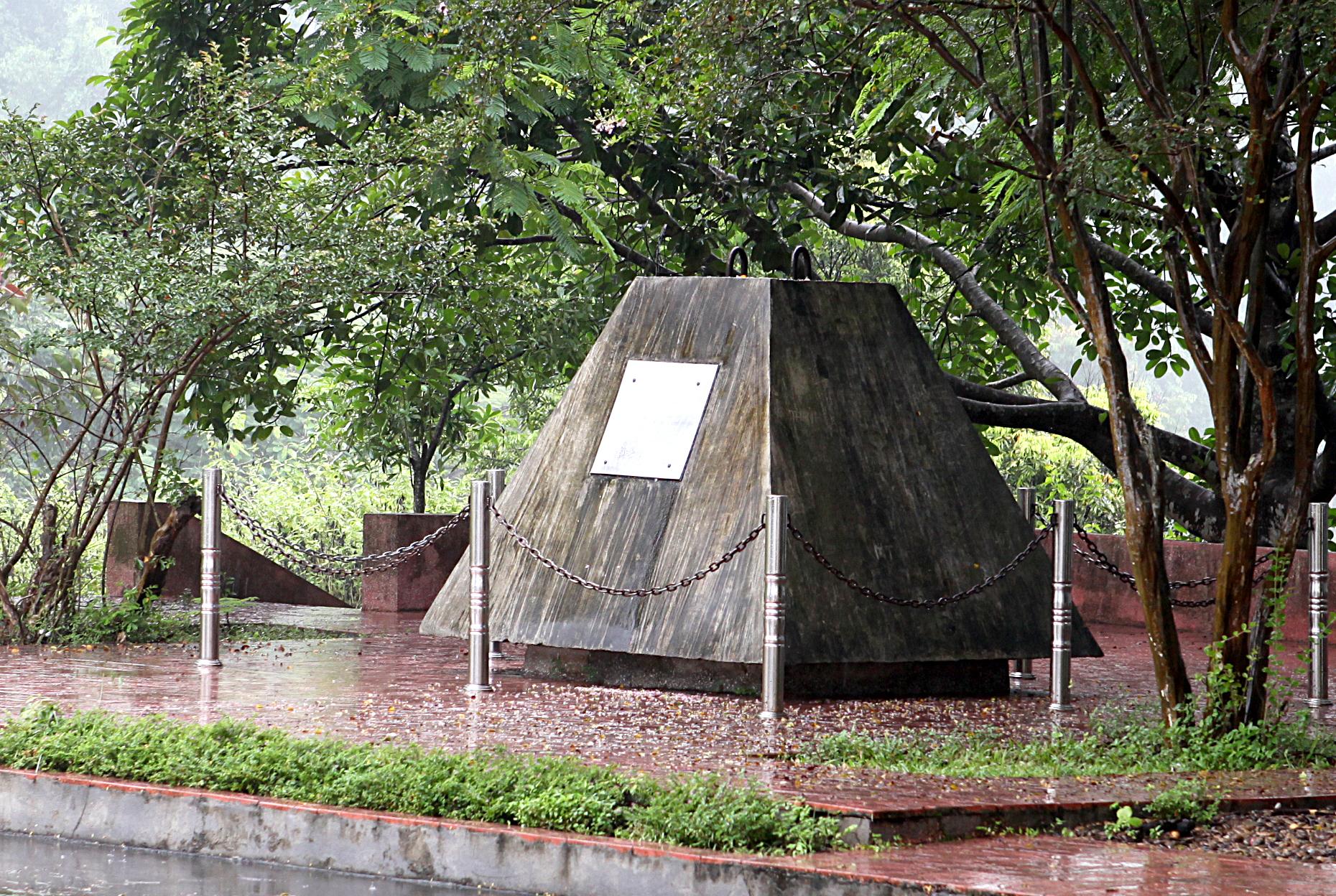
Original photograph of the concrete monument preserving the letter at Hoa Binh Hydropower Plant (Source: EVN)
The story behind the letter: Hoa Binh Dam in 1983
To understand why the letter was written, it helps to return to the early 1980s, when construction of the Hoa Binh Hydropower Plant was entering a particularly demanding stage. The project had officially broken ground on November 6, 1979, with substantial technical assistance from the Soviet Union. Vietnam was still facing significant economic and material challenges in the years following the war, making the development of such a large hydropower facility an extraordinary undertaking that required thousands of workers, engineers, and specialists to cooperate over many years.
According to historical accounts published by Vietnam Electricity (EVN), the idea of leaving a message for future generations came from Bogachenko, the chief Soviet specialist working at the construction site. He introduced a tradition practiced in the Soviet Union and several other countries, where workers involved in building major dams would place written messages inside sealed bottles or containers before burying them within the structures. The intention was that, if the dam were eventually dismantled centuries later, whoever discovered the letter would learn about the people who built it and the circumstances they had faced.
The proposal received support from Do Muoi, then Deputy Chairman of Vietnam's Council of Ministers and head of the committee overseeing construction of the Hoa Binh project. However, he suggested that a message of such historical significance deserved a more formal and accessible resting place than the interior of the dam itself. After discussions with Soviet specialists and project leaders, it was decided that the letter would be preserved inside a separate concrete monument within the power plant grounds, where its location could remain known to future generations.
This decision transformed what might otherwise have been a hidden construction-site tradition into a public symbol of remembrance. Rather than relying on the unlikely possibility that someone might discover the message during demolition work, the builders created a designated place where their words could remain protected until the appointed day.
The Sealing Ceremony on January 30, 1983
The letter was officially sealed on the afternoon of January 30, 1983, during a ceremony held near the Central Dispatch Building at the construction site. Historical records describe a gathering of approximately 250 Soviet youth delegates, 350 Vietnamese youth delegates, and thousands of construction workers. The occasion was particularly memorable because Soviet cosmonaut Svetlana Savitskaya, the second woman to travel into space, was among the participants.
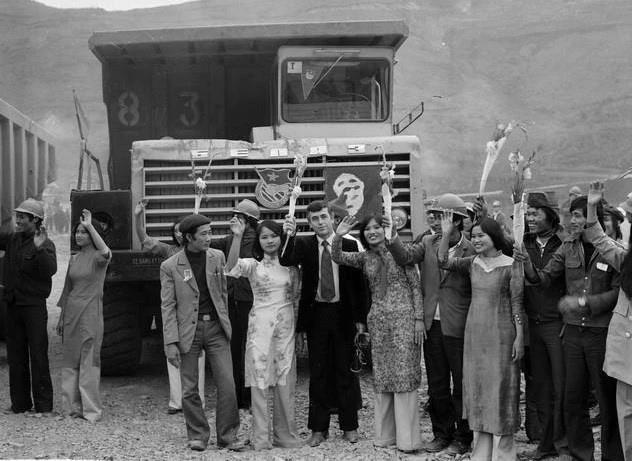
Archival photograph of Vietnamese and Soviet workers during the construction of Hoa Binh Hydropower Plant (Source: VietnamPlus or EVN)
During the ceremony, the message was read aloud in Vietnamese by construction commander Ngo Xuan Loc and in Russian by a Soviet representative named Giaseplin. The two versions were then rolled up, placed inside a hollow copper container, and sealed within the concrete monument. Four representatives were selected to secure the commemorative plaque: Soviet specialist Bogachenko, Vietnamese youth leader Vu Mao, construction commander Ngo Xuan Loc, and cosmonaut Svetlana Savitskaya.
Their selection was carefully considered. The organizers wanted the participants to represent different generations, both men and women, Vietnam and the Soviet Union, and even a symbolic connection between Earth and space. Savitskaya's presence fulfilled the final requirement, giving the ceremony an unusual dimension that reflected the scientific optimism of the period.
For those gathered on the construction site that afternoon, the ceremony marked more than the preservation of a document. It was an opportunity to acknowledge the work they were undertaking and to imagine how their achievements might be remembered by people living in a world they would never see. With the plaque secured and the letter safely enclosed, the countdown to January 1, 2100, officially began.
Why will the letter at Hoa Binh Dam be opened in 2100?
The decision to keep the letter sealed until January 1, 2100, was not arbitrary. Do Xuan Duy, the former head of Russian-language interpretation at the construction project and one of the people involved in preparing the message, later explained the reasoning in an interview published by EVN. The builders wanted their words to reach a genuinely different generation, one whose members would have no personal memories of the period in which the dam was constructed.
If the letter had been scheduled for opening only a few decades later, many of the original workers might still have been alive to share their experiences directly. Even a date exactly 100 years after the sealing ceremony would have left a small possibility that someone born in 1983 might witness the opening. By choosing the year 2100, the organizers extended the interval to almost 117 years, making it far more likely that the message would be received entirely by people born after the construction period.
This reasoning gives the letter a meaning that extends beyond its physical preservation. Its purpose was to establish a connection between people separated not merely by time, but by lived experience. The workers wanted future readers to understand the circumstances in which the power plant had been built, without relying on the memories of those who had participated in the project.
Some historical accounts also refer to early engineering projections about sediment accumulation in Hoa Binh Lake and the possibility that the facility might require major reconstruction after many decades of operation. However, these should not be interpreted as a confirmed prediction that the dam will be demolished or cease operating in 2100. The date engraved on the monument refers specifically to the intended opening of the letter, not to an established end date for the hydropower plant.
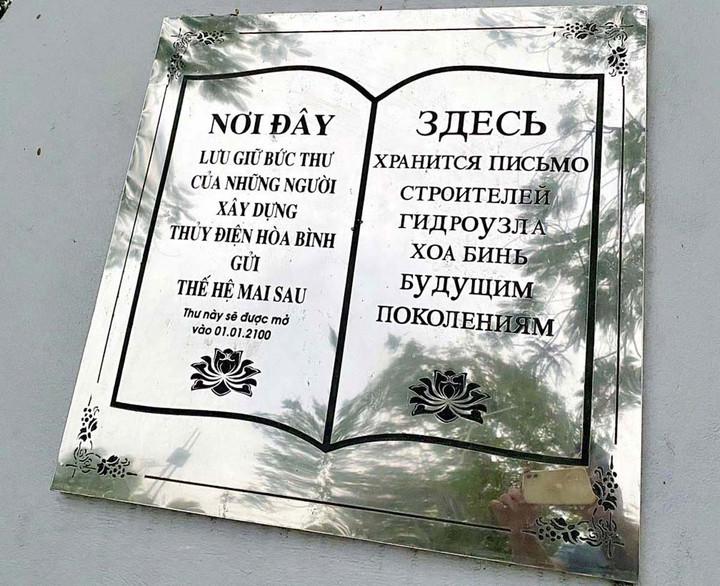
Close-up of the bilingual Vietnamese-Russian plaque showing the scheduled opening date
What is written inside the letter to the future?
Perhaps the most intriguing aspect of the Letter to the Future at Hoa Binh Dam is that its original sealed copies have never been opened. This has naturally encouraged speculation about what the message might contain, particularly as decades have passed and the scheduled opening date remains so far away. However, the contents are not entirely unknown, as several people involved in drafting and translating the letter have shared details of its preparation and central themes.
According to Do Xuan Duy, the message was compiled from contributions made by construction workers, engineers, writers, journalists, and intellectuals from different parts of Vietnam. Rather than representing the thoughts of one individual, it brought together the experiences and aspirations of many people connected to the project. The final letter was approximately 700 words long, prepared in Vietnamese and Russian, and carefully transcribed onto special writing material supplied from the Soviet Union.
Among those who contributed ideas was Thep Moi, a respected Vietnamese writer and journalist. His writing drew on Son Tinh, a legendary figure from Vietnamese folklore associated with mountains and the struggle against rising waters. By comparing modern construction workers to the heroic figure of Son Tinh, he connected the engineering achievements of the twentieth century with a much older cultural narrative about humanity's relationship with nature.

Mr Do Xuan Duy was talking about the message inside the letter (Source: dienlucngaynay.com)
The message reflected the determination of those building the hydropower plant, the hardships they had endured, and the sacrifices required to complete the project. It also acknowledged the support provided by communities across Vietnam, whose contributions ranged from essential supplies to food and other resources needed by the workers. Another important theme was the friendship between Vietnam and the Soviet Union, whose cooperation played a central role in the development of the facility.
Beyond these historical details, the letter expressed a broader hope that the completed power plant would help provide electricity, improve living conditions, and support Vietnam's development. These aspirations are particularly meaningful when viewed against the economic and technological limitations of the early 1980s. For the people who wrote the message, the dam represented not only an engineering achievement but also an investment in the lives of those who would come after them.
Does the letter contain predictions about the future?
The long period of secrecy surrounding the letter has given rise to various rumors, including suggestions that it contains predictions about Vietnam's future or mysterious information hidden within the dam. Some stories have even attempted to connect the monument with supernatural beliefs, treating its sealed contents as something more enigmatic than a historical document. There is, however, no credible evidence supporting these interpretations.
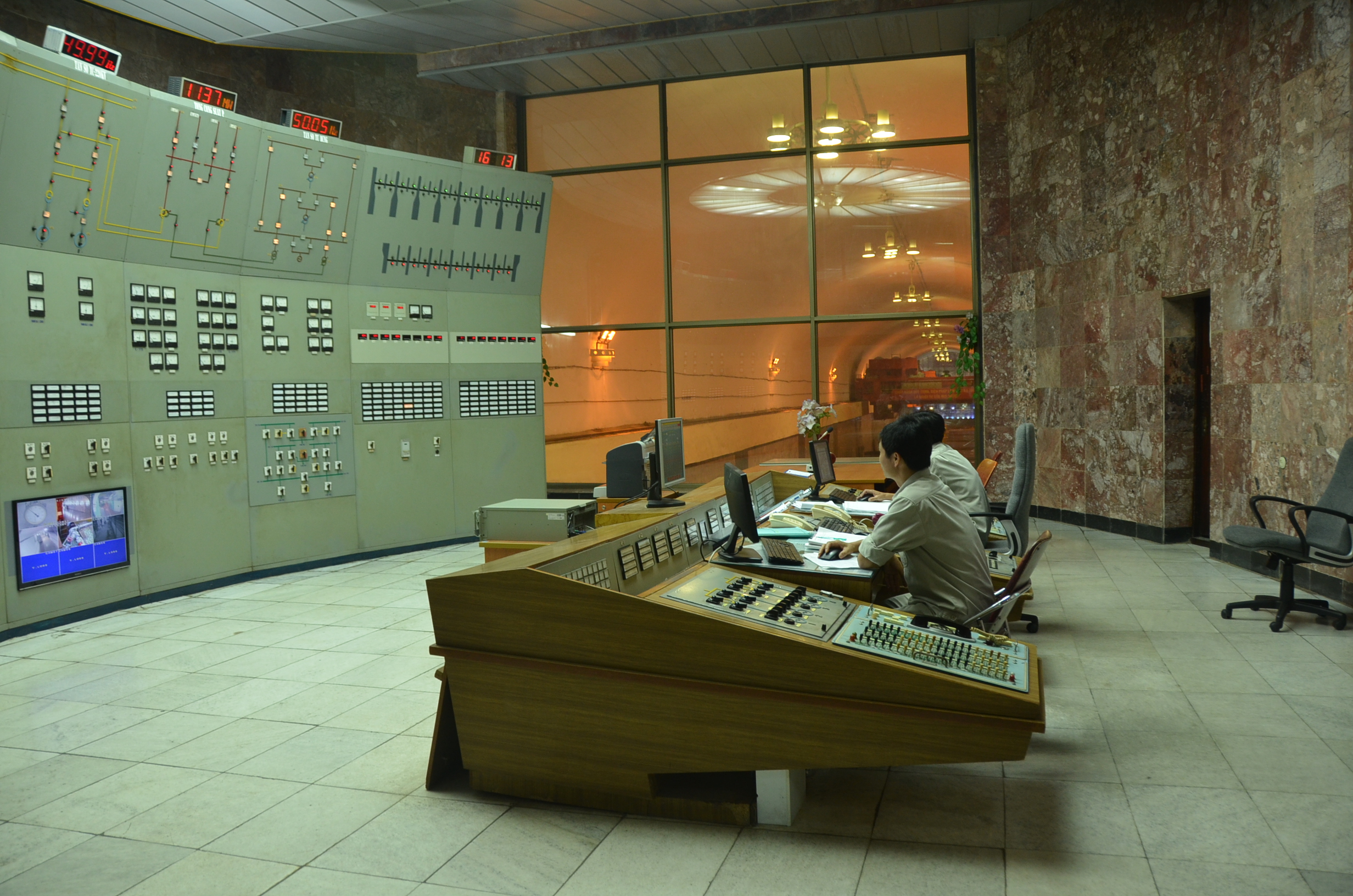
Historical photograph showing the interior or control room of Hoa Binh Hydropower Plant (Source: EVN)
In a 2015 interview published by Vietnam Electricity, Do Xuan Duy directly rejected such speculation, explaining that the message was intended to preserve the thoughts, experiences, and hopes of the generation that built the hydropower plant. His account suggests that the letter's significance lies in its historical testimony rather than in any supposed prophecy. What makes it remarkable is the deliberate effort to communicate across more than a century, allowing future readers to encounter the perspective of people whose daily lives and working conditions may be difficult to imagine by 2100.
For further historical context, readers can consult Vietnam Electricity's account of the letter and the choice of the year 2100, which includes recollections from Do Xuan Duy and details of the original ceremony.
Where is the letter to the future at Hoa Binh Dam located?
The letter remains preserved within the grounds of Hoa Binh Hydropower Plant, in the area near the Central Dispatch Building. The facility is situated along the Da River in what was formerly Hoa Binh City, Hoa Binh Province. Following Vietnam's administrative reorganization in 2025, the location is officially part of Hoa Binh Ward, Phu Tho Province, although travelers may still encounter the former provincial name on older maps, travel guides, and historical records.
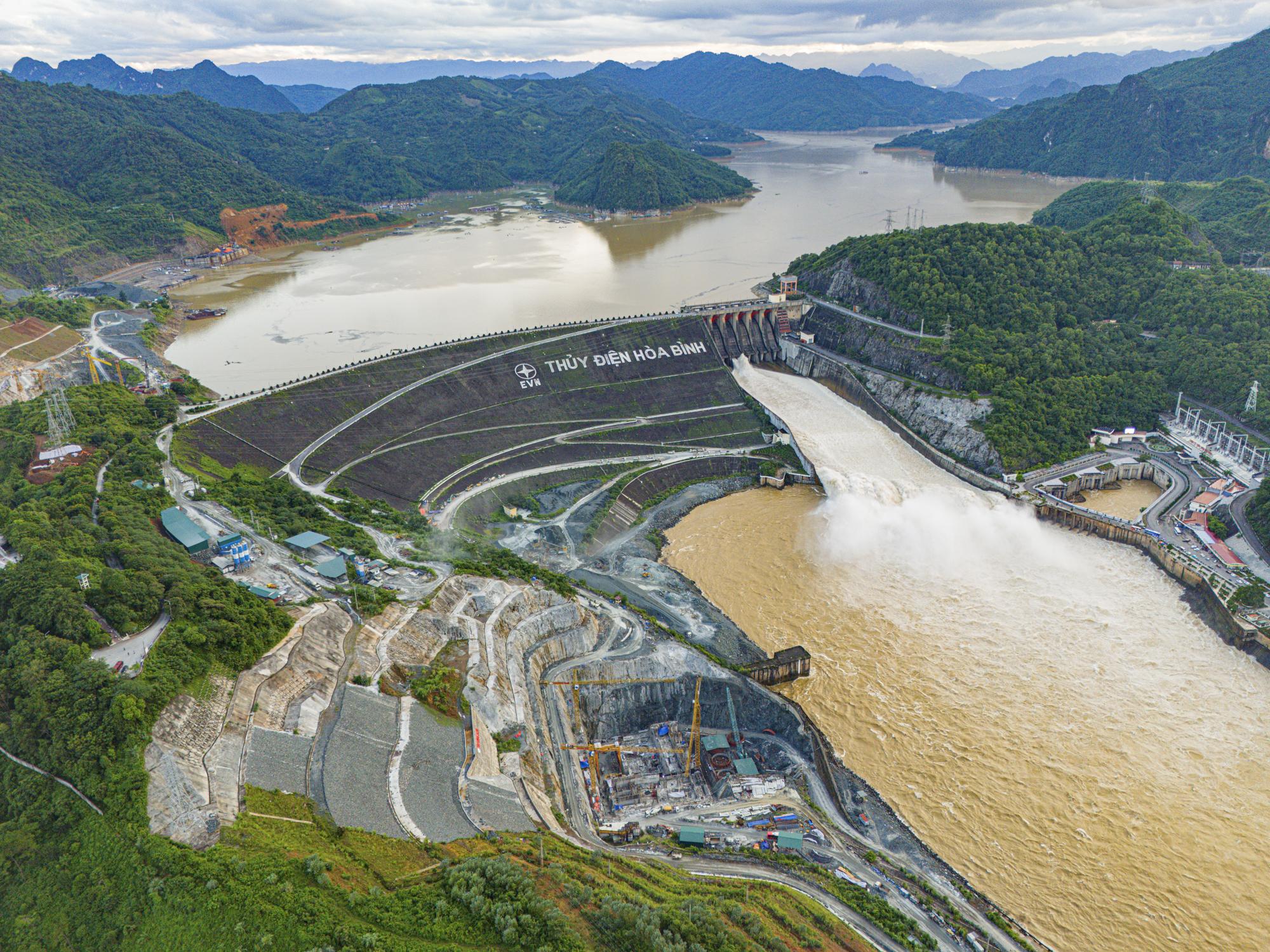
Panoramic photograph of Hoa Binh Hydropower Plant and the Da River landscape
Visitors interested in the story can learn more about the monument as part of an exploration of the hydropower complex, depending on the visitor arrangements available at the time. The wider site is also associated with several historically significant places, including the plant's heritage exhibition area, its underground turbine hall, a memorial dedicated to those who died during construction, and the Ho Chi Minh Monument on Ong Tuong Hill. Together, these sites offer a broader understanding of the scale of the project and its place in Vietnam's modern history.
It is important to remember that Hoa Binh Hydropower Plant remains an operating facility, and access to certain areas is restricted for operational and safety reasons. Travelers should confirm current visiting arrangements with the plant's management or an authorized tour operator before arriving, particularly if they hope to see the letter's monument. Not every part of the complex is necessarily included in standard visitor routes, and access conditions may change.
For those planning to explore the surrounding landscape, the reservoir itself is another major attraction. Our guide to things to do around Hoa Binh Lake introduces the area's scenery, outdoor activities, and places worth discovering beyond the hydropower plant.
A message across generations on the Da River
More than forty years have passed since the letter was sealed, and the landscape around the Da River has undergone a remarkable transformation. The Hoa Binh Hydropower Plant was completed and entered operation, while the vast reservoir that formed upstream reshaped the surrounding valleys and became an important feature of the region's natural and cultural landscape. Today, the area is familiar to many travelers for its forested hills, expansive lake views, lakeside villages, and opportunities to experience a quieter side of northern Vietnam.
Yet the Letter to the Future offers a reminder that this peaceful scenery is closely connected to a demanding period of construction and national development. Long before visitors came to enjoy boat journeys and lakeside retreats, thousands of people were working along the Da River to create an electricity-generating facility that they hoped would serve the country for generations. Their message, preserved within a block of concrete, gives that history a distinctly human dimension.
There is something especially thought-provoking about the writers' decision to address people they would never meet. They could not have known how Vietnam would change over the following century, what technologies would emerge, or how future generations might interpret their experiences. What they could do was preserve a record of their efforts and entrust it to the future, believing that the story of their work would still matter long after their own lifetimes.
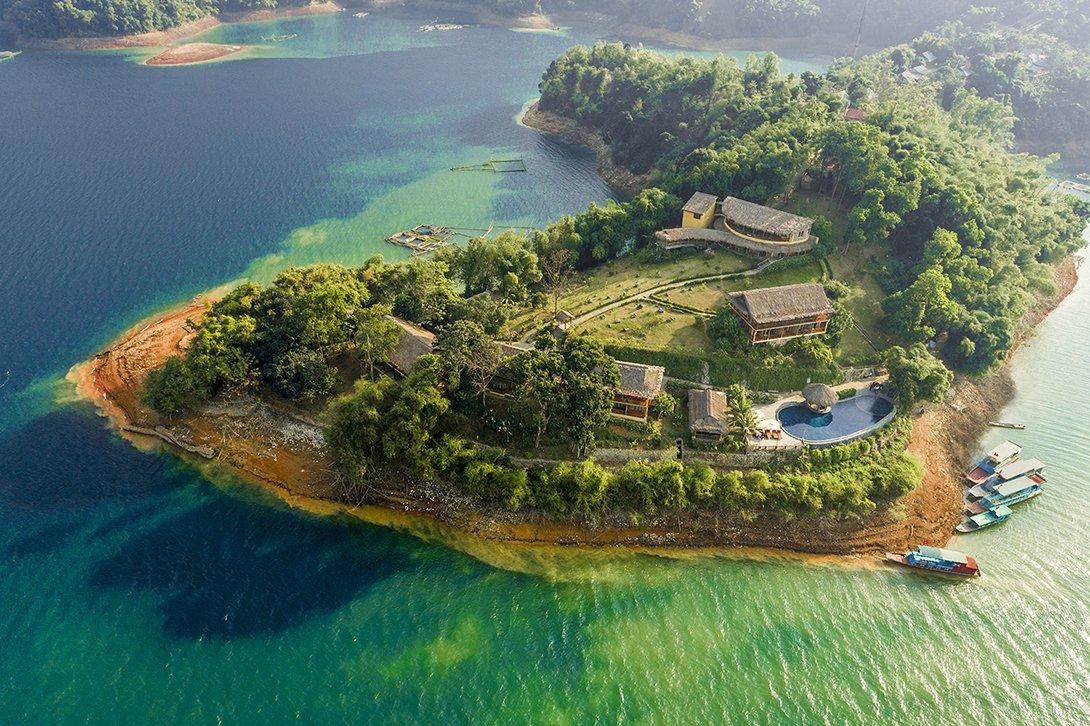
A corner of Mai Chau Hideaway Lake Resort
When the letter is finally opened on January 1, 2100, its readers will encounter the hopes and perspectives of people who lived in a very different Vietnam. Whether those words feel distant or surprisingly familiar remains to be seen, but the act of preserving them has already given the message an enduring place in the history of Hoa Binh Dam.
Continue your journey around Hoa Binh Lake
For travelers who enjoy discovering the history behind a destination, Hoa Binh Dam can be a meaningful starting point for a wider journey through the Da River region. Beyond the hydropower complex, the landscape gradually opens into Hoa Binh Lake, where mountains descend toward the water and the atmosphere feels far removed from the pace of Vietnam's larger cities. Exploring this area offers an opportunity to appreciate not only the region's natural beauty but also the remarkable transformation brought about by the construction of the dam.
Set along the lakeshore, Mai Chau Hideaway Lake Resort provides a peaceful base for discovering this part of northern Vietnam. Guests can enjoy views of the surrounding mountains, spend time by the water, and take part in outdoor experiences that reveal a different side of the Da River landscape. Those looking to combine relaxation with more active exploration can also consider the resort's two-day Mai Chau kayaking and bamboo forest cycling tour, which brings together lakeside scenery, local villages, and outdoor activities.
Read more: 2 Days - 1 Night: Kayaking On Da River - Biking In Bamboo Forest
The Letter to the Future may first draw your attention to the extraordinary history of Hoa Binh Dam, but the surrounding landscape offers its own reasons to explore. From the engineering achievements of the past to the quiet beauty of the lake today, this is a destination where history and nature are closely intertwined. If you are planning a journey through northern Vietnam, consider extending your visit with a stay at Mai Chau Hideaway Lake Resort and experiencing the Da River region beyond the dam itself.