If you want to delve deeper into local culture while traveling in Hoa Binh, the Muong Cultural Space Museum is a very worthwhile stop. More than just a place to display artifacts, the museum almost completely recreates the traditional life of the Muong people through stilt houses, household items, clothing, and many unique cultural values.
Introduction to the Muong Cultural Space Museum
The Muong Cultural Space Museum is a unique cultural destination located in Group 6, Thong Nhat Ward (formerly Hoa Binh City), Phu Tho Province. The museum is built on a limestone valley covering approximately 5 hectares. This area has been closely associated with the life of the Muong people for a very long time.
Nestled amidst the distinctive natural landscape of the northern midland and mountainous regions, this place offers a sense of intimacy and tranquility. Upon visiting, tourists can clearly experience the scenery of a traditional Muong village where nature and culture blend harmoniously.
.png "Bảo tàng Không gian văn hóa Mường (Nguồn: Traveloka)")
Muong Cultural Space Museum (Source: Traveloka)
The unique feature of the Hoa Hinh Muong Cultural Space Museum lies in its exhibition modeled after ancient villages. Within the museum grounds are characteristic stilt houses such as the Lang house, Au house, Nooc house, and Noc Troi house. Each house represents a social class in the ancient Muong community. Through this, visitors can gain a better understanding of the daily life, architecture, and traditional customs of this ethnic group.
More than just a repository of thousands of precious artifacts, the Muong Cultural Space Museum is also a space for research and experiencing indigenous culture. During their visit, tourists can explore ancient stilt house architecture and learn about traditional household items. These experiences help viewers gain a deeper understanding of the history, life, and cultural identity of the Muong people.
Experience visiting the Muong Cultural Space Museum
To make your visit to the Muong Cultural Space Museum more convenient and fulfilling, visitors should research important information beforehand, such as directions, ticket prices, opening hours, and the best time to visit. Since the museum is built in the style of a traditional Muong village with many stilt houses scattered throughout the valley, prior preparation will allow you ample time to explore the unique cultural space.
Directions to the Muong Cultural Space Museum
The museum is located on Tay Tien Road, in the former Hoa Binh city area, about 70-80 km from the center of Hanoi. Thanks to its relatively short distance, visitors can easily make a day trip or combine it with a visit to Hoa Binh and Mai Chau. Below are some popular routes and means of transportation to get to the museum.
- Hoa Lac – Hoa Binh Expressway (fastest route)
This is the most popular route for tourists due to its quick travel time and convenient location. From central Hanoi, follow Thang Long Boulevard to the Hoa Lac area, then continue onto the Hoa Lac – Hoa Binh expressway. After exiting the expressway, travel to the center of Hoa Binh city and then follow Tay Tien road for about 6-7 km to reach the museum.
.png "Tuyến cao tốc Hòa Lạc – Hòa Bình (Nguồn: Báo Tiền Phong)")
Hoa Lac – Hoa Binh Expressway (Source: Tien Phong Newspaper)
Travel time on this route is usually around 1.5 hours if traffic is smooth. However, the expressway section is toll-free. For vehicles with fewer than 12 seats, the estimated fee is around 35,000 – 40,000 VND per trip. Thanks to the wide road and fewer non-motorized vehicles, this route saves considerable time compared to other routes.
Besides the expressway, tourists can also choose National Highway 6. The popular route is Hanoi – Ha Dong – Xuan Mai – National Highway 6 – Hoa Binh city. This route does not charge tolls, making it quite suitable for those traveling by motorbike or wanting to save money.
Travel time along this route is typically around 2 to 2.5 hours due to passing through many residential areas and a high density of vehicles. However, National Highway 6 has the advantage of offering easy stops for rest or to enjoy local eateries along the way.
- Travel by limousine or shuttle service.
If you don't want to drive yourself, you can opt for limousine services from Hanoi to Hoa Binh or Mai Chau. A convenient option is the limousine service offered by Mai Chau Hideaway Lake Resort , which specializes in transporting guests from Hanoi to the resort in Mai Chau.
The vehicles typically pick up passengers in central Hanoi and travel along the highway, making the journey comfortable and time-saving. Tourists can combine their trip with a visit to the Muong Cultural Space Museum on the way to Mai Chau, then continue their journey to the resort. This is a suitable option for travelers who want a relaxing trip without having to drive themselves.
Ticket prices and opening hours
Before visiting the Muong Hoa Binh Cultural Space Museum , visitors should check the ticket prices and opening hours beforehand. Knowing this information will help you plan your itinerary more effectively and avoid arriving when the museum is about to close.
.png "Bảo tàng có giá vé tham quan khá hợp lý (Nguồn: Vivu)")
The museum has a fairly reasonable entrance fee (Source: Vivu).
Below is a price list for tickets and some sample services for visitors.
Entrance tickets
- Adults: 50,000 VND/person
- Students: 25,000 VND/person
- Discounted rate according to current regulations: 15,000 VND/person
This price is considered quite reasonable for an open-air museum with a large area and many traditional cultural artifacts.
Guided tour services
To gain a deeper understanding of the history and significance of each stilt house in the museum, visitors can hire a tour guide. They will provide detailed information about the social structure of the Muong people, the architecture of the stilt houses, and the artifacts on display.
- Vietnamese-language guide fee: 100,000 VND/person
- English-speaking guide: 120,000 VND/session
- French-speaking guide: 120,000 VND/session
Guide fees may vary depending on the number of people in the group.
Photography fee
The ancient stilt house architecture and surrounding natural landscape create many beautiful photo opportunities. Therefore, the museum has specific regulations regarding photography within its grounds.
- Travel photography: 100,000 VND/camera
- Professional photography and wedding photography: 400,000 VND/camera
Filming fees
For filming activities, especially professional filming, visitors also need to register and pay the required fees.
- Travel videography: 100,000 VND/camera
- Professional videography: 400,000 VND/camera
Opening hours
To serve tourists who want to explore and learn about Muong culture, the museum is open most days of the week with fairly flexible hours.
- Opening hours: 7:30 AM – 5:30 PM
Generally, visitors should come in the morning or early afternoon to have enough time to explore the entire complex. A full tour of the Muong Cultural Space Museum usually takes about 1.5 to 2 hours if you want to visit each stilt house and thoroughly explore the exhibits.
The best time to visit
The museum can be visited at any time of year, but many visitors find the period from October to April to be ideal. This is when the weather in Northern Vietnam is generally cooler and drier, not too hot and with less rain. This makes it easier to move between the stilt houses on the grounds.
On clear days, the limestone valley surrounding the museum appears very peaceful and spacious. The natural light is also quite beautiful, creating favorable conditions for taking photos and exploring the traditional stilt house architecture. Many visitors often choose to come in the morning or early afternoon, when the weather is pleasant and the museum is not too crowded.
Conversely, in the summer, the weather can be quite hot around midday, so if you're going during this time, you should arrive earlier in the day for a more comfortable experience.
Notes for visitors
When visiting the Muong Cultural Space Museum , tourists should keep in mind a few small details to make their trip smoother and more fulfilling.
- Comfortable footwear is recommended, preferably sneakers or low-heeled shoes for easy movement, as the museum is located on a hillside.
- Please take care to protect the artifacts and avoid touching them without permission, as many are of great historical and cultural value.
The history of the formation of the Muong Cultural Space Museum
The Muong Cultural Space Museum was established with the goal of preserving and showcasing the traditional cultural values of the Muong people – one of the ethnic groups with a long history in the midland and mountainous regions of Northern Vietnam. The idea for building the museum originated from artist Vu Duc Hieu , who spent many years collecting artifacts and researching the cultural life of the Muong community.
During his field trips to numerous villages in Hoa Binh province, he collected thousands of artifacts related to traditional life, beliefs, and architecture. From this personal collection, a project to build an open-air museum gradually took shape, with the desire to authentically recreate the life of the Muong people in the past.
After years of preparation and construction, the Muong Hoa Binh Cultural Space Museum officially opened its doors to visitors in 2007. The museum complex is designed according to the model of a traditional Muong village, with stilt houses representing each social class in the ancient Muong community.
Today, this place is not only a display site for over 3,000 artifacts but also a unique cultural and tourist space, helping visitors better understand the history, customs, and life of the Muong people.
Read more: Discover the beauty of Mother Goddess worship through a unique cultural journey
Explore the exhibits in the Muong Cultural Space Museum.
One of the unique features of the Muong Cultural Space Museum is its exhibition model based on traditional Muong villages. Instead of placing artifacts in enclosed exhibition rooms like many conventional museums, it recreates the living space of the Muong people through ancient stilt houses. Each house represents a social class in the ancient Muong community, helping visitors better understand the social structure, daily life, and traditional customs.
Lang House – the space of the Muong aristocracy
The Lang House is the largest and most prominent structure in the museum complex. In ancient Muong society, the "Lang" was the leading class in the community, similar to a local ruler or noble. Therefore, Lang Houses were usually large in scale, had sturdy architecture, and were built on high ground within the complex.
.png "Nhà Lang/Quan Lang (Nguồn: Muong)")
Lang House/Quan Lang (Source: Muong)
Inside the Lang house, many important artifacts related to the life of this class are displayed, such as religious objects, household items, ancient weapons, and items that reflected social status. When visiting this house, tourists can gain a clearer understanding of the role and power of the Lang class in the Muong community in the past.
European House – a space for the wealthy class.
The Au house represents the middle class in ancient Muong society. Families belonging to this class usually had relatively stable economic conditions and a comfortable life. Therefore, the architecture of the Au house was spacious and solidly built, but not as imposing as the Lang house.
.png "Nhà Ậu (Nguồn: Muong)")
Au House (Source: Muong)
Inside the museum, many familiar items from daily life are displayed, such as cooking utensils, work tools, looms, and items made of bamboo and rattan. Through these artifacts, visitors can gain a better understanding of the lives of well-off Muong families in the past.
The Rooftop House – a recreation of the life of ordinary people.
The Noóc house is a common type of house for most Muong people in traditional society. Its architecture is simpler than the Lang and Au houses, but it still retains all the characteristics of a Muong stilt house, such as a low roof, wooden floor, and spacious common living area.
.png "Nhà Noóc (Nguồn: Muong)")
Noóc House (Source: Muong)
This house vividly recreates the life of Muong peasant families. Inside, there are many farming tools, hunting equipment, cooking utensils, and everyday household items. Thanks to this, visitors can imagine the simple yet closely connected lifestyle of the ancient Muong people.
The House of the Low Roof – the lower class in Muong society.
The "Noc Troi House" is the simplest type of house in the exhibition area. It recreates the living space of the lower classes in ancient Muong society, usually poor laborers or dependents in the community.
.png "Nhà Nóc Trọi (Nguồn: Muong)")
House with a thatched roof (Source: Muong)
The architecture of the house is quite small and rustic, with building materials mainly consisting of bamboo, wood, and leaves. Inside, there are only a few basic household items. Although simple, this house helps visitors better understand the stratification in traditional Muong society as well as the differences in living conditions between classes.
By exploring each stilt house, visitors will gain a more comprehensive understanding of the social structure and cultural life of the Muong community in the past. This is also what makes the Muong Cultural Space Museum in Hoa Binh one of the unique and culturally rich open-air museums in the northern region.
The museum features unique artifacts and cultural values.
Not only impressive for its traditional stilt house architecture, the Muong Cultural Space Museum also preserves thousands of valuable artifacts related to the life and culture of the Muong people. These artifacts, collected from various regions of Hoa Binh and the surrounding areas, help to recreate a fairly complete picture of the daily life, work, and beliefs of the Muong community in the past.
A collection of traditional household items and farming tools.
A large portion of the museum's exhibits consists of familiar household items and farming tools used by the ancient Muong people. Visitors can find rice mortars, copper pots, jars, bamboo baskets, and agricultural tools such as hoes, sickles, and hunting implements.
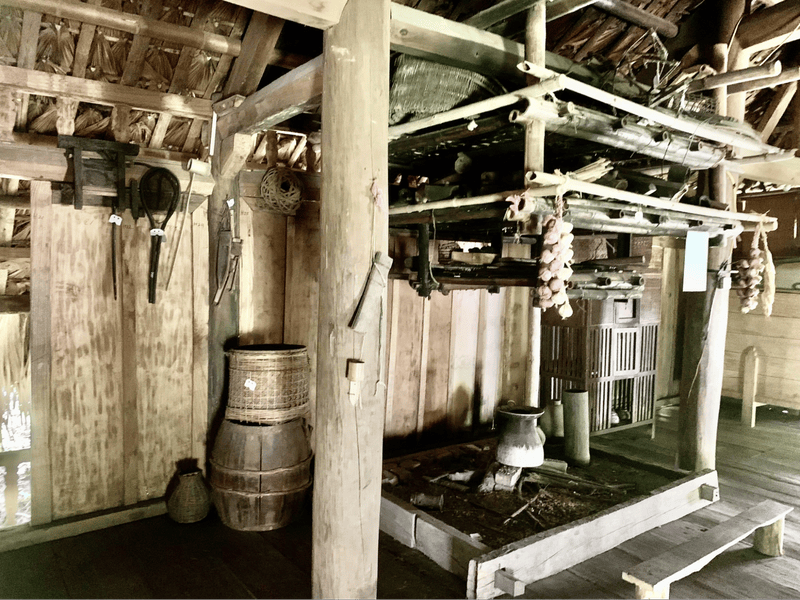
The fireplace in Lang's house
These seemingly simple items clearly reflect the agricultural lifestyle of the Muong people. Through the way they are crafted and used, visitors can gain a better understanding of their skill, labor experience, and how they utilize natural resources in their lives.
Traditional clothing and handicrafts
The traditional costumes of the Muong people are also a highlight in the exhibition areas. The dresses and blouses with their delicate patterns and harmonious colors showcase the cultural beauty and distinctive aesthetic taste of the Muong people.
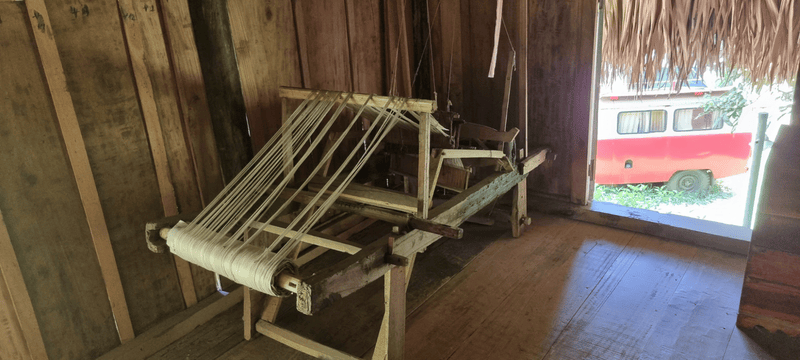
Spinning by the Muong people
In addition, the museum also showcases many handicrafts such as woven fabrics, bamboo and rattan woven items, and handcrafted household goods. These are traditional crafts that have long been associated with the lives of the Muong people and are still maintained in some villages today.
Musical instruments and spiritual cultural elements
Music and beliefs are an important part of the spiritual life of the Muong people. Therefore, the museum also displays many traditional musical instruments such as gongs and cymbals, along with items used in rituals and festivals.
In addition, several artifacts related to folk beliefs and ancestor worship are also preserved here. These artifacts help visitors better understand the rich spiritual life and the role of rituals in the Muong community.
A fascinating experience visiting the Muong Hoa Binh Cultural Space Museum.
More than just a place to display artifacts, the Muong Hoa Binh Cultural Space Museum offers many interesting experiences for visitors. The museum space is built according to the model of a traditional Muong village, so visiting it is like a journey to discover the life of the Muong people in the past.
Take a stroll through the traditional Muong village.
One of the most memorable experiences at the museum is strolling through the expansive grounds with ancient stilt houses scattered throughout the valley. Small paths lead visitors through each house, garden, and traditional courtyard, creating the feeling of stepping into a real Muong village.
.png "Không gian yên tĩnh cùng cảnh quan thiên nhiên xung quanh giúp chuyến tham quan trở nên thư giãn và gần gũi hơn với văn hóa bản địa (Nguồn: Tạp chí điện tử Văn hóa và Phát triển)")
The tranquil atmosphere and surrounding natural landscape make the tour more relaxing and closer to the local culture. (Source: Culture and Development e-magazine)
Learn about the architecture of ancient stilt houses.
Each stilt house in the museum has its own unique architectural features, reflecting the living conditions and social status of each class within the Muong community. Upon closer observation, visitors will notice differences in spatial layout, building materials, and interior decoration.
.png "Tìm hiểu kiến trúc nhà sàn cổ (Nguồn: Tạp chí điện tử Văn hóa và Phát triển)")
Exploring the architecture of ancient stilt houses (Source: Culture and Development online magazine)
Learning about stilt house architecture helps tourists understand more about traditional construction techniques and how the Muong people adapt to the natural conditions of the mountainous region.
Take photos and enjoy the unique cultural atmosphere.
With its ancient stilt houses, bamboo fences, dirt roads, and surrounding limestone valleys, the museum offers many impressive photo opportunities. Therefore, many visitors often spend time strolling around the grounds to capture memorable photos.
.png "Không gian bình yên trong Bảo tàng Không gian Văn hóa Mường (Nguồn: Tạp chí điện tử Văn hóa và Phát triển)")
A peaceful atmosphere in the Muong Cultural Space Museum (Source: Culture and Development online magazine)
This culturally rich highland setting is also often chosen as a backdrop for travel or wedding photoshoots.
Tourist attractions near the Muong Cultural Space Museum
After visiting the Muong Cultural Space Museum , tourists can combine their visit with exploring many other famous tourist attractions in the area. Thanks to its location near the old Hoa Binh city center, getting to these places is quite convenient.
Hoa Binh Hydroelectric Power Plant
The Hoa Binh hydroelectric power plant is one of the largest and most famous hydroelectric projects in Vietnam. It is not only a project of significant importance to the national power grid but also a popular tourist attraction.
When visiting, tourists can learn about the history of the power plant's construction, tour the hydroelectric dam area, and enjoy panoramic views of the Da River from above.
Hoa Binh Lake
Hoa Binh Lake is an artificial lake formed after the construction of a hydroelectric dam on the Da River. With its vast area and majestic natural scenery, it is often likened to a "Ha Long Bay in the mountains".
Visitors can participate in activities such as boat tours on the lake, explore the small islands, or simply enjoy the peaceful scenery of the river amidst the mountains and forests.
Mai Chau Valley
If time permits, visitors can continue their journey to Mai Chau Valley – one of the famous tourist destinations in the Northwest region. From the museum area, the distance to Mai Chau is about 60 km, making it quite convenient to combine a visit with other activities.
Mai Chau is famous for its peaceful villages, lush green rice fields, and the unique cultural life of its ethnic minorities. It is an ideal destination for tourists who want to experience the pristine natural environment and the slow pace of life in the mountainous region.
Read more: Mai Chau hot springs: A unique experience in the heart of nature
With its profound cultural value and intimate, authentic display, the Muong Cultural Space Museum is not only an interesting tourist attraction but also a place that helps visitors better understand the identity of the Muong people in Hoa Binh. From stilt house architecture and ancient artifacts to stories about their lives and beliefs, every corner of the museum offers memorable experiences.