Easy kayaking for beginners really is possible on your very first try - kayaks are built to float and stay upright on their own, so you don't need any prior skill to get on the water safely. The learning curve is short: three basic strokes, one safe way to get in and out of the boat, and a calm, sheltered stretch of water is all it takes for most first-timers to feel comfortable within 15–20 minutes.
This guide breaks down exactly how to start, what beginner spots in Vietnam make it easiest, and what an easy first session actually costs in 2026.
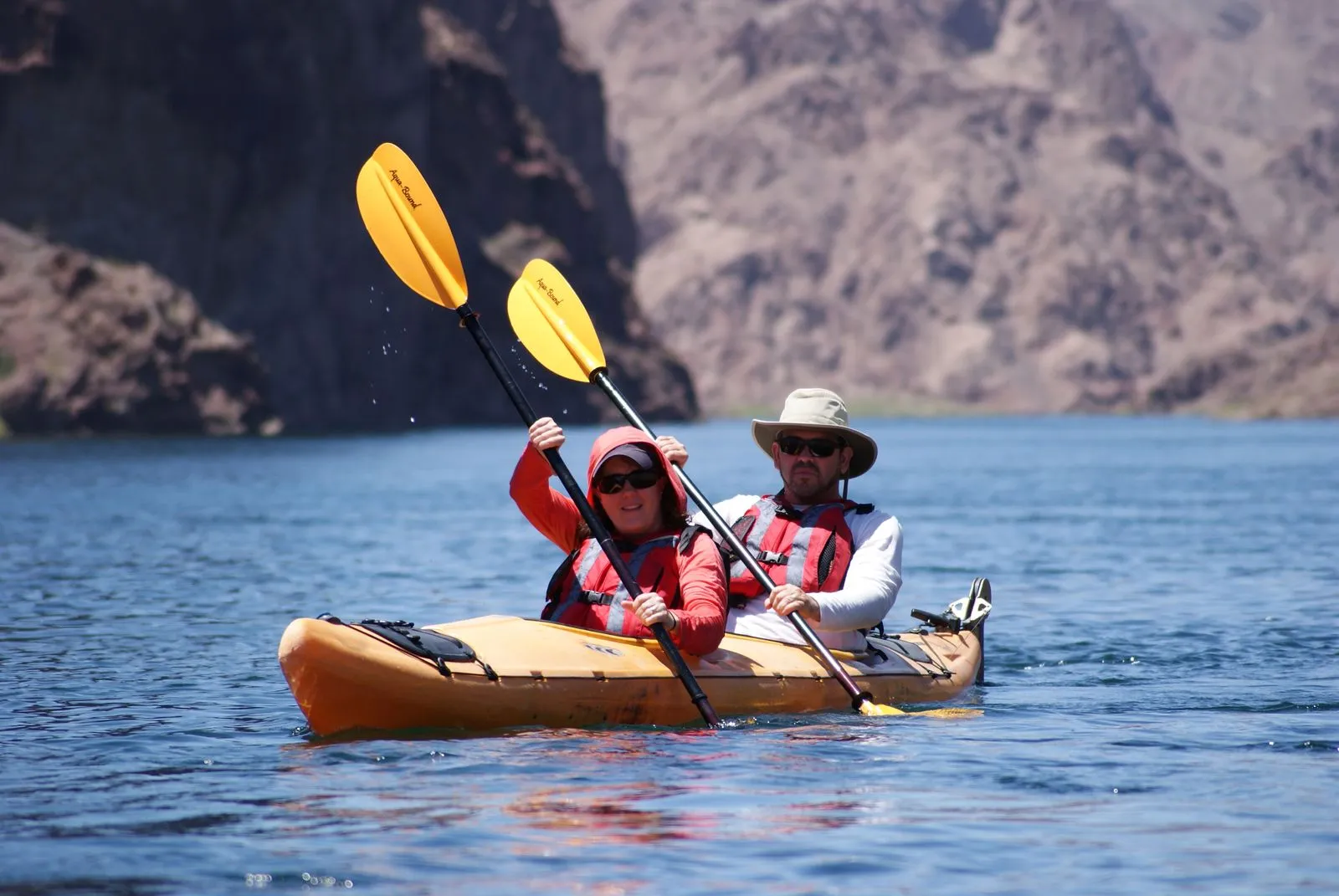
A relaxed first-time paddler smiling mid-stroke on calm, flat water, mountains in the background - conveys "this is easier than you think (Source: Evolution Expeditions)
Is kayaking really easy for complete beginners?
Yes - a kayak is one of the most stable small boats you can sit in, and it does not require strength or athletic background to control. Instructors consistently point out that beginners don't need to "fight" for balance; the hull is designed to self-right, so sitting upright with a relaxed grip and letting the boat move slightly under you is usually enough to stay steady (Source: NRS Kayaking Guide). Most of the anxiety first-timers feel disappears the moment they realize the boat won't tip just from shifting their weight.
What actually determines whether your first outing feels easy is the water, not your paddling skill. Paddling coaches note that most beginner "accidents" are really a mismatch between paddler and conditions - open windy water, strong current, or heavy boat traffic are hard even for confident paddlers, while flat, sheltered, shallow water is forgiving of every beginner mistake (Source: Kayak Starved Rock Campground). This is why a calm reservoir or a quiet lake bay, rather than a river or the open sea, is the right place to try kayaking for the first time.
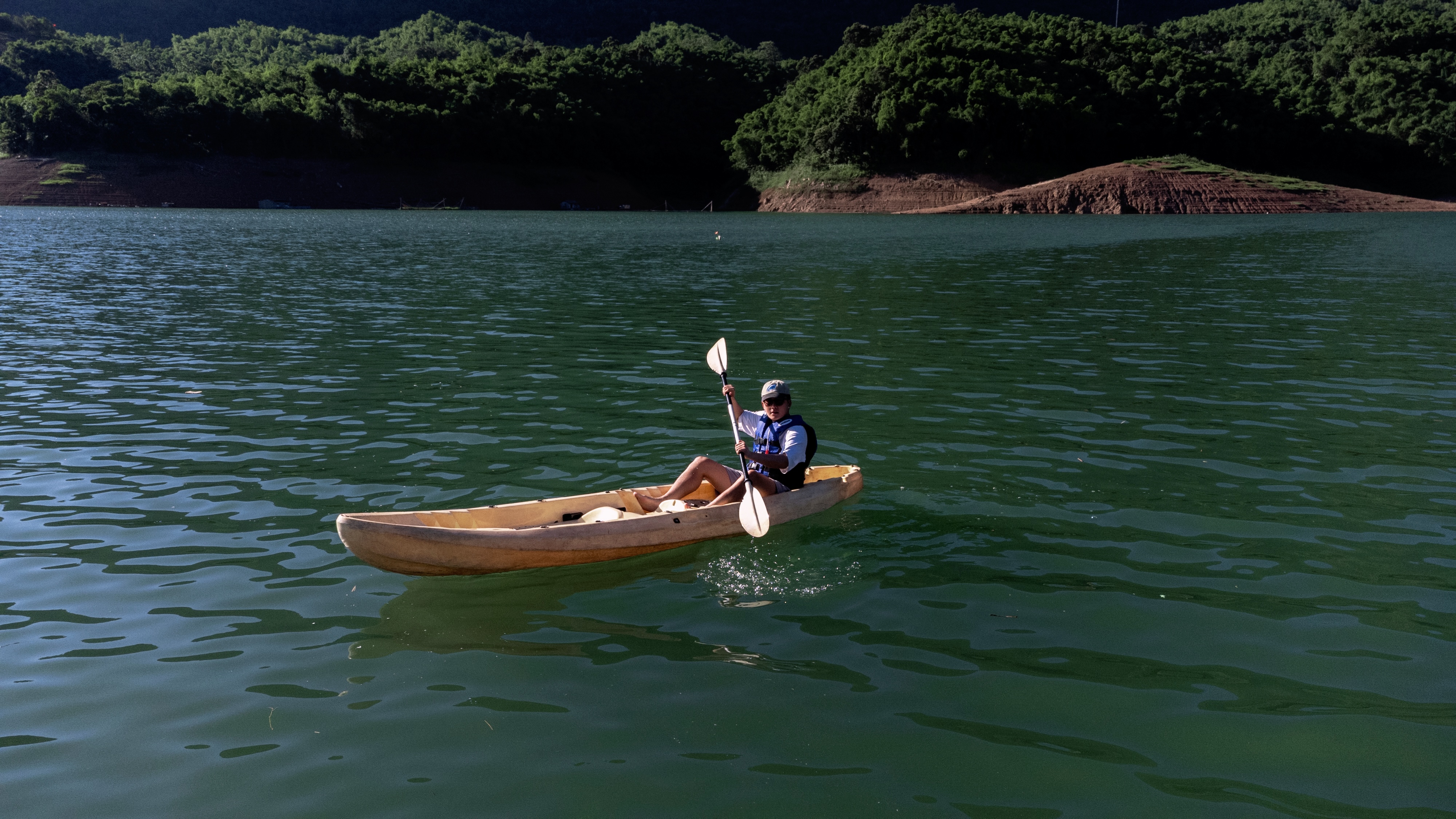
Kayaking is very easy for beginners
Age and fitness matter far less than most travelers assume. Children, grandparents, and complete non-swimmers with a properly fitted life jacket can all paddle a stable recreational kayak on flat water, and many resorts in Vietnam treat it as a family activity rather than an extreme sport. If you can sit upright, hold a paddle, and follow simple instructions, you already have everything you need for an easy first session.
The 3 basic kayak strokes you actually need
You only need three strokes to handle almost every beginner situation: going forward, stopping or reversing, and turning. Paddling instructors agree that mastering just these three gives new kayakers full control before they ever need an advanced technique (Source: Paddling.com). Practicing each one for a few minutes on calm water is enough to build real confidence.
- Forward stroke: Hold the paddle with both hands roughly shoulder-width apart, dip one blade into the water near your feet at a slight angle, and pull it back toward your hip while rotating your torso rather than just pulling with your arms - this protects your shoulders and gives you far more power (Source: Outdoor Action Plan). Repeat on alternating sides to travel in a straight line.
- Reverse stroke (to stop or slow down): Use the same motion in reverse, planting the blade near your hip and pushing forward toward your feet. This is the stroke you'll use most often around other boats, swimmers, or when approaching a dock.
- Sweep stroke (to turn): Make a wide, arcing stroke out from the bow to the stern on one side only. A gentle, controlled sweep turns the kayak smoothly, while short panicked strokes on one side just spin you in circles - small, calm corrections always work better than big dramatic ones (Source: Kayak Starved Rock Campground).
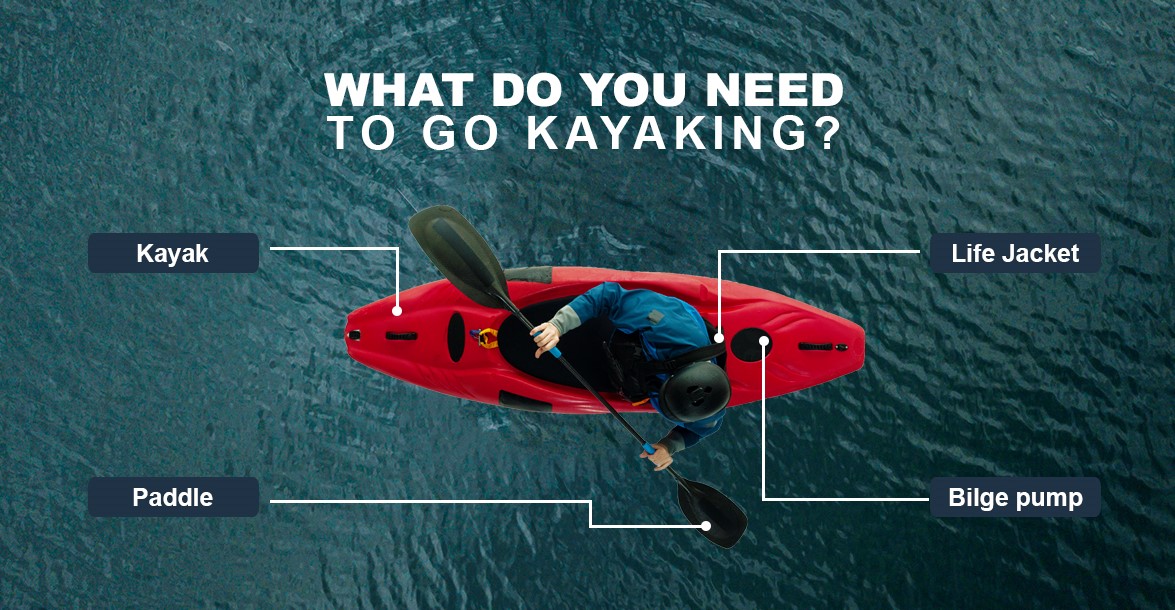
What do you need to go kayaking? (Source: EZ Dock)
How to get in and out of a kayak without tipping over
Getting in and out is the moment most beginners worry about - and it's also the easiest part to get right with the correct technique. The safest launch point is a calm, shallow, sandy or gravel shoreline or a low, stable dock, rather than rocks or a steep bank. Sit down into the seat first, then bring your legs in one at a time, keeping your weight centered and low the entire time.
Read more: Hoa Binh Lake Travel Guide: One-Day All-Inclusive Tour From Hanoi, Itinerary & Costs
If you're launching from a dock or a resort pontoon, place your paddle across the kayak behind the cockpit and use it as a brace against the dock for extra stability while you lower yourself in. Staff at organized kayaking spots will usually steady the boat for you during this step, which removes almost all of the risk for a first-timer. Exiting simply reverses the process: paddle close to shore or the dock, then push yourself up and out using your hands rather than standing up inside the boat.
A few small habits make a big difference here. Always keep your body weight low and centered rather than leaning to one side, move slowly rather than rushing the transition, and never stand up while the kayak is still floating in open water. These same three habits also apply every time you land the kayak on a beach or return it to a resort pier at the end of a session.
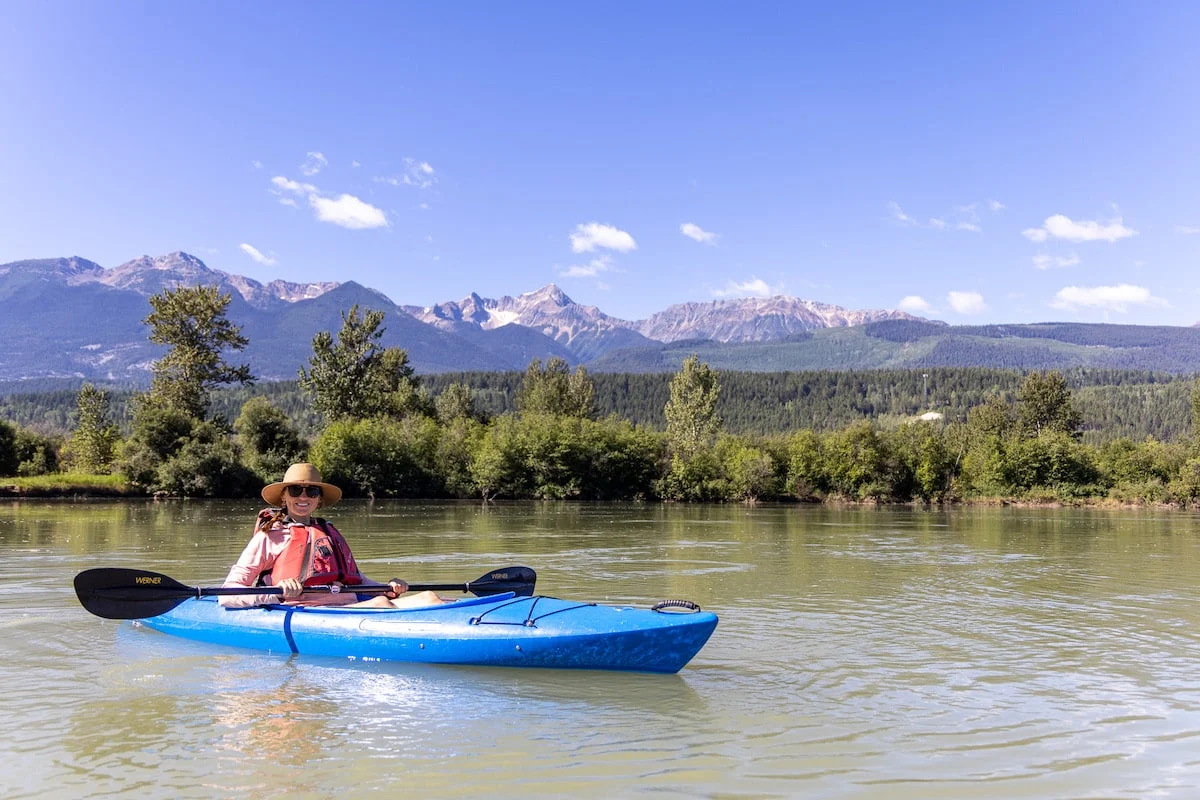
A kayak at a wooden dock while a guest steps in, illustrating the assisted, low-risk entry technique (Source: Bearfoot Theory)
The best easy kayaking spot near Hanoi: Hoa Binh Lake
For travelers based in Hanoi, Hoa Binh Lake is one of the most beginner-friendly places in northern Vietnam to try kayaking for the first time. The lake spans roughly 8,000 hectares and is dotted with 47 limestone islets, but its bays and coves stay calm and largely current-free, which is exactly the kind of protected water beginner paddlers should look for. Unlike a river with current or a coastal beach with waves, this reservoir behaves more like a giant, sheltered lake, making it forgiving even if your strokes aren't perfect yet.
Ngoi Hoa Bay, inside the lake, is a particularly good first-timer stretch: flat water framed by limestone cliffs, with no boat traffic in the narrower coves. Paddling here early in the morning, before the wind picks up, gives beginners the calmest possible conditions and a paddling backdrop that locals compare to a miniature Ha Long Bay. You can read a full breakdown of this route in our guide to Ban Ngoi Village, including how to combine it with a lakeside stay.
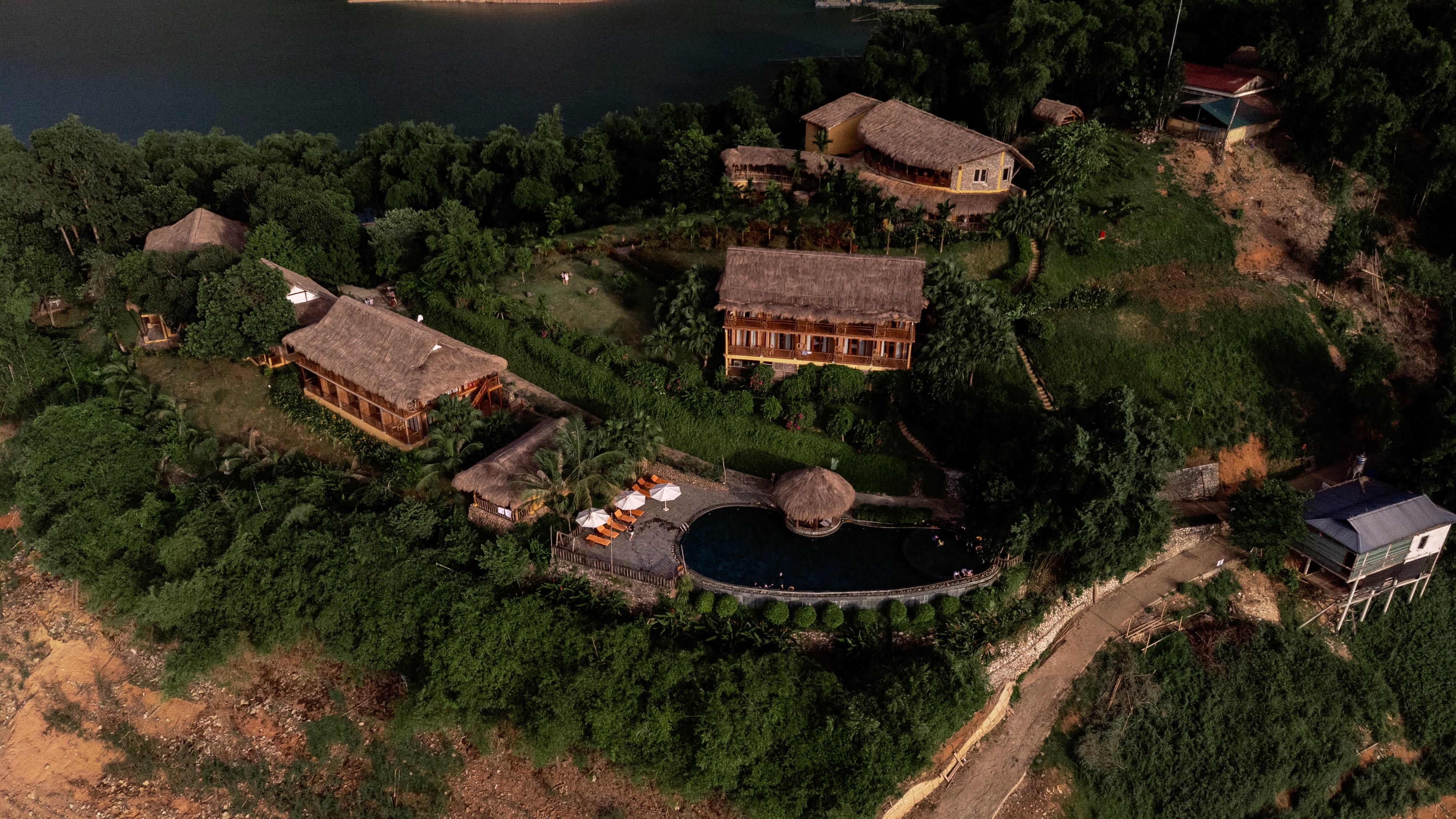
Aerial or waterline shot of Mai Chau Hideaway's peninsula setting
Read more: Ban Ngoi Village: The Muong Hamlet Hiding Inside Hoa Binh Lake
Basing yourself at a resort that already runs kayaks directly from its own shoreline removes almost every logistical headache of trying this as a total beginner. Mai Chau Hideaway Lake Resort sits on its own peninsula surrounded on nearly every side by Hoa Binh Lake, so guests can walk from their room straight to the water's edge and paddle out into a quiet, sheltered cove rather than driving to a separate launch point.
Why first-timers do well kayaking at Mai Chau Hideaway
Guests consistently describe kayaking as the one activity they didn't expect to enjoy as much as they did. Several travelers reviewing their stay on TripAdvisor singled it out directly, describing it as a "must do" alongside the resort's infinity pool and calling the lake "perfect for kayaking" even when they only watched from the poolside (Source: TripAdvisor guest reviews). For a beginner, that kind of low-pressure, resort-run setup - paddle out, turn around, paddle back - is exactly what makes a first attempt feel easy rather than intimidating.
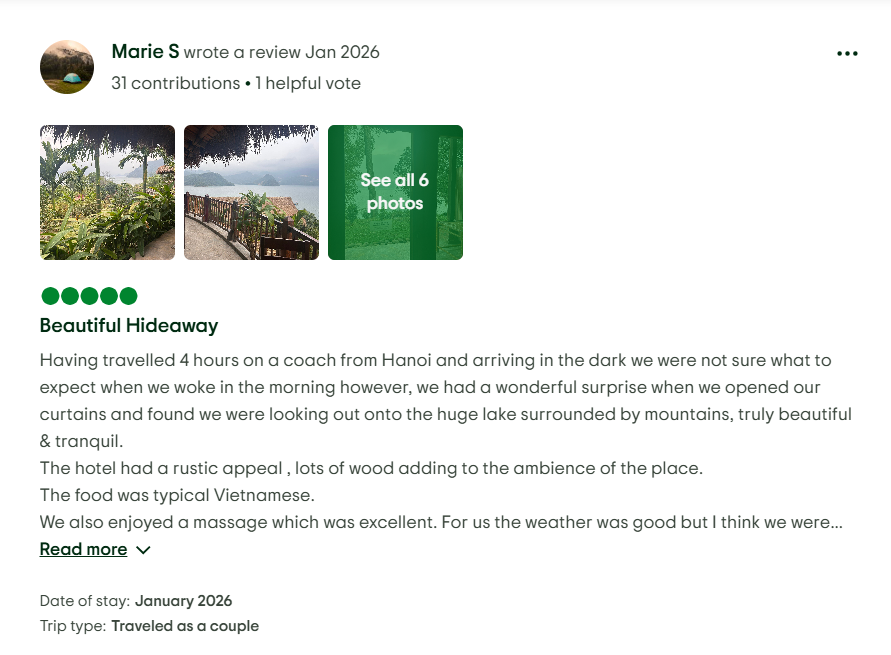
Guest’s review about Mai Chau Hideaway Lake Resorts
Part of what makes the resort's stretch of water forgiving is the setting itself. The lake here is genuinely sheltered by surrounding hills rather than open, so wind and chop stay minimal on most mornings, and the resort's own natural-stone infinity pool sits right at the water's edge as a backup if anyone in your group prefers to stay dry. Several guests renting rooms at the resort's lakeview rooms mention pairing an early kayak session with breakfast on their balcony, since both look directly onto the same calm bay.
Kayaking and bamboo rafting are typically included as complimentary activities for guests staying at the resort, rather than a paid add-on booked separately - a detail past visitors have flagged as one of the better surprises of their stay (Source: TripAdvisor guest reviews). One family staying in early July described paddling together across the still morning lake, pausing near local fishermen pulling in their nets, as the moment that captured the entire point of their trip - the kind of easy, unstructured first paddle that beginners tend to remember longest.
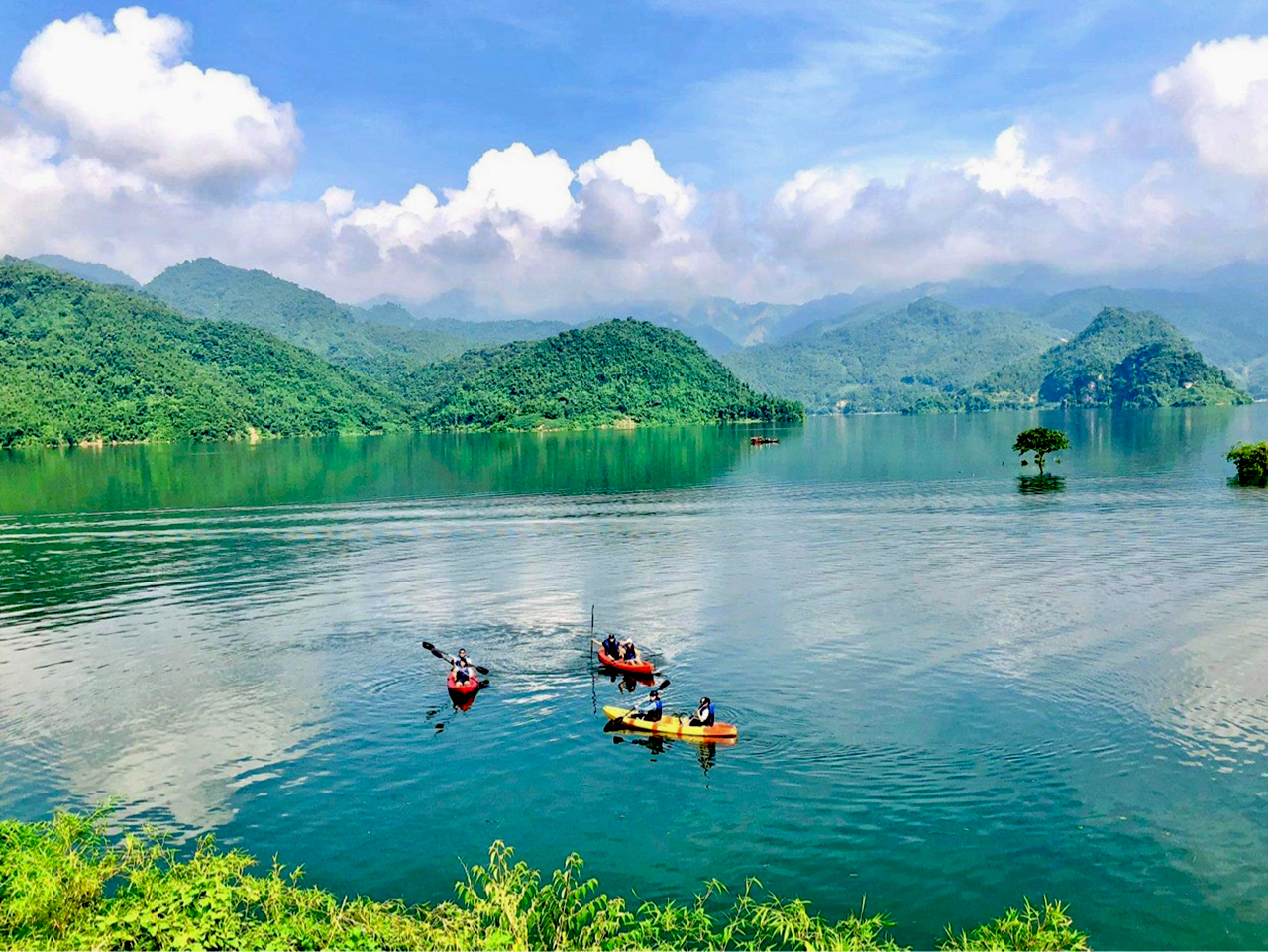
A team paddling two kayaks side by side on still morning water, soft golden-hour light, limestone hills in the background (Source: Collected)
Beginner kayaking safety rules you should never skip
Wearing a properly fitted life jacket at all times is the single non-negotiable rule of easy kayaking for beginners, regardless of how calm the water looks or how strong a swimmer you are. A jacket should sit snugly with no gap that lets it ride up over your chin, and reputable operators and resorts will fit yours before you ever step into the boat. This one habit accounts for the majority of the difference between a minor mishap and a real emergency on the water.
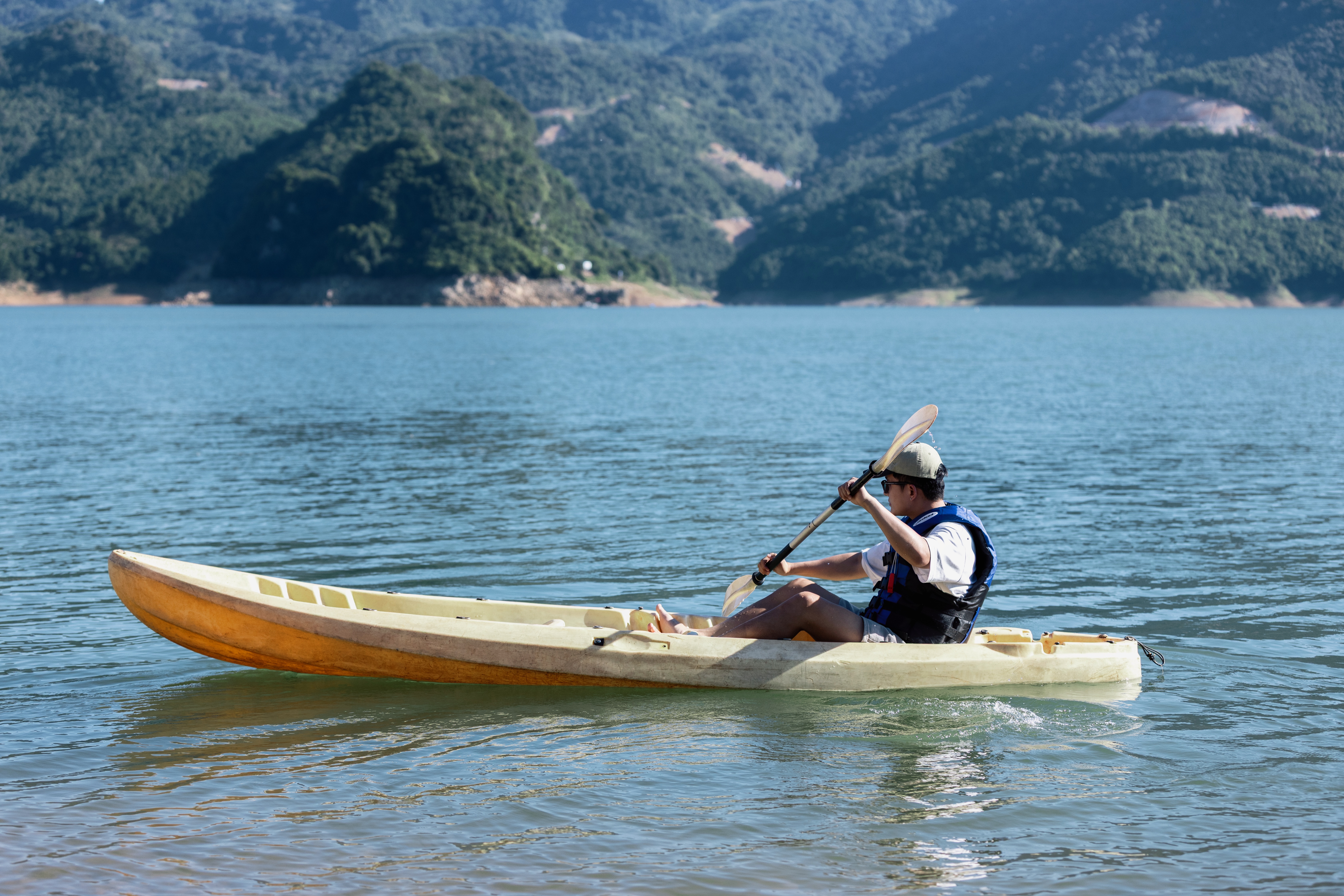
Some tips for beginner when they go kayaking
Checking conditions before you launch matters just as much as anything you do once you're paddling. Look at wind, cloud cover, and any posted warnings, and avoid heading out if a storm is visibly building over the mountains - Hoa Binh Lake's weather can shift quickly, especially during the rainy season from May to October. If you or anyone in your group is prone to motion sickness, it's worth noting that even calm-water paddling can trigger it on longer sessions, so pack tablets in advance if needed.
Basic water-safety instructors recommend a simple mental checklist for any emergency: alert people nearby, breathe slowly to stay calm, and call for help if the situation requires it (Source: Outdoor Action Plan). For a first-timer, the realistic version of this is much simpler - stay near your guide or resort staff, don't paddle beyond the marked or suggested area, and always kayak with at least one other person rather than alone.
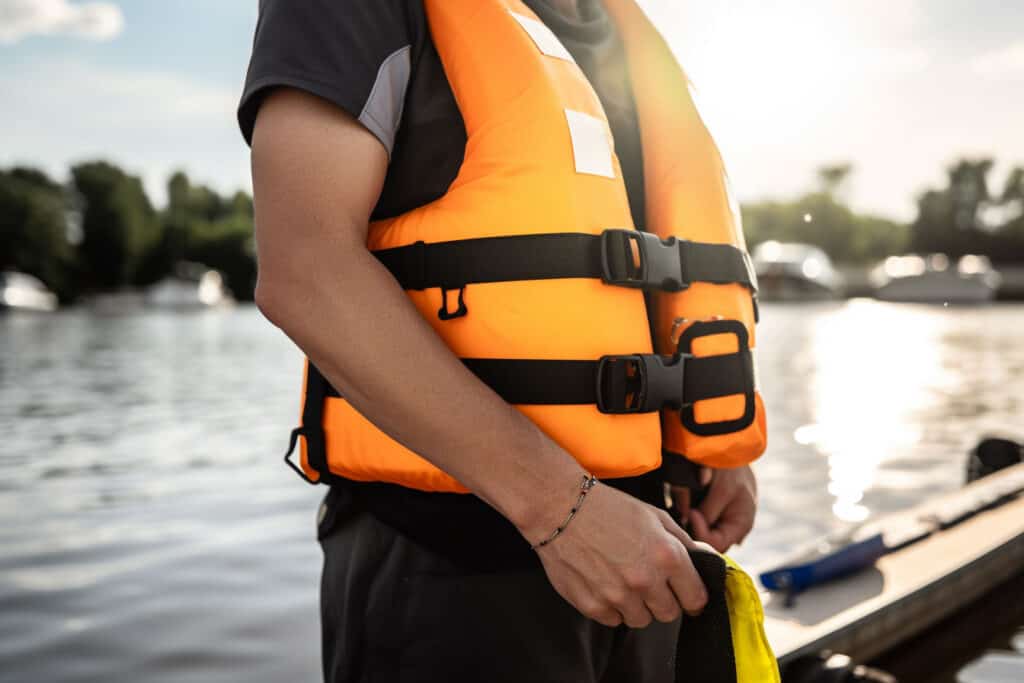
Close-up of a correctly fitted life jacket being adjusted (Source: Collected)
What to wear and bring for your first kayak session
Quick-dry clothing beats cotton every time on a kayak, since cotton stays wet and heavy the moment it gets splashed while synthetic or swim fabric dries within minutes. Pack a change of dry clothes for afterward, and choose closed-toe water shoes or sandals with a back strap rather than flip-flops, which tend to float away the first time your foot slips.
Sun protection deserves more attention than most first-timers give it, since open water reflects sunlight back up at you as well as down from above. Reef-safe sunscreen, a hat with a chin strap, and polarized sunglasses with a retaining strap will keep a two-hour paddle comfortable instead of leaving you sunburned and squinting. A dry bag or a simple waterproof phone pouch is worth bringing along too, so you can actually photograph the limestone scenery instead of leaving your phone locked in a locker.
Finally, pack light and pack smart: a reusable water bottle, a small towel, and any medication you might need are usually all that fit comfortably in a kayak's dry storage. Guests staying at Mai Chau Hideaway Lake Resort can leave the gear list short, since life jackets, paddles, and kayaks are provided on-site - you really only need to show up in the right clothes.
Easy kayaking prices in Vietnam: What to expect in 2026

Sunrise on Hoa Binh Lake
Independent kayak or SUP rental on lakes like Hoa Binh typically runs around 150,000–200,000 VND per boat per hour, with better rates for full-day rental, while some smaller operators charge closer to 50,000 VND per person for shorter sessions. Guided full-package tours cost more but remove all the beginner guesswork: day-trip packages that include a kayak, life jacket, guide, and meals start around 750,000 VND per person, rising to roughly 2,500,000 VND or more for a 2-day/1-night version with accommodation included.
|
Option
|
Typical price (2026)
|
Best for
|
|
Self-rental kayak/SUP (per hour)
|
150,000 - 200,000 VND
|
Confident beginners, short sessions
|
|
Per-person hourly rental
|
~50,000 VND
|
Budget travelers, solo paddlers
|
|
Guided day-trip package
|
From 750,000 VND
|
First-timers who want instruction included
|
|
2 days/1 night guided package
|
2,500,000+ VND
|
Travelers combining kayaking with an overnight stay
|
|
Resort-included kayaking (e.g. Mai Chau Hideaway)
|
Complimentary for guests
|
Anyone who prefers zero extra logistics
|
For travelers who want more time on the water without juggling separate bookings, resort-based options are usually the simplest value: kayaking is typically included at no extra charge for guests, and staff handle the paddle, life jacket, and launch point as part of your stay. If you'd rather extend the adventure further, the 3-Day 2-Night Kayaking and Cycling tour pairs a beginner-friendly paddling route with cycling into Pu Luong Nature Reserve.
FAQ about easy kayaking for beginners
Do I need to know how to swim to go kayaking?
→ It's strongly recommended but not always required on calm, shallow water if you wear a properly fitted life jacket at all times and stay close to your guide or resort staff.
How long does it take to learn the basics?
→ Most beginners feel comfortable with the forward, reverse, and turning strokes within 15–20 minutes of calm-water practice.
Is kayaking safe for children and older travelers?
→ Yes, on flat, sheltered water with a correctly sized life jacket and adult supervision, kayaking is considered an all-ages activity suitable for both young children and grandparents.
What's the difference between a kayak and a SUP for beginners?
→ A sit-in or sit-on-top kayak is generally more stable and requires less core balance than a stand-up paddleboard, making it the easier starting point for most complete beginners.
Is Hoa Binh Lake a good place to try kayaking for the first time?
→ Yes - its sheltered bays, minimal current, and calm mornings make it one of the more forgiving beginner-friendly kayaking spots within day-trip distance of Hanoi.
Ready to try your first paddle without any of the guesswork? Book a lakeview stay at Mai Chau Hideaway Lake Resort and step straight from your room onto Hoa Binh Lake's calmest cove - kayaks, life jackets, and a beginner-friendly launch point are already waiting at the resort's own shoreline.